
Scientists have successfully tested a heartbeat-powered pacemaker in living pigs, whose hearts are similar to humans’ in size and function. Researchers say this is an important step toward developing battery-free implantable medical devices. Current pacemaker batteries have a life span of seven to 10 years, and replacing them entails expensive surgery.
The new “symbiotic pacemaker” consists of three components: a wafer-sized generator attached to the heart that converts the organ’s mechanical energy into electrical energy; a power-management unit that has a capacitor to store that energy; and the pacemaker itself, which stimulates and regulates the heart muscle.
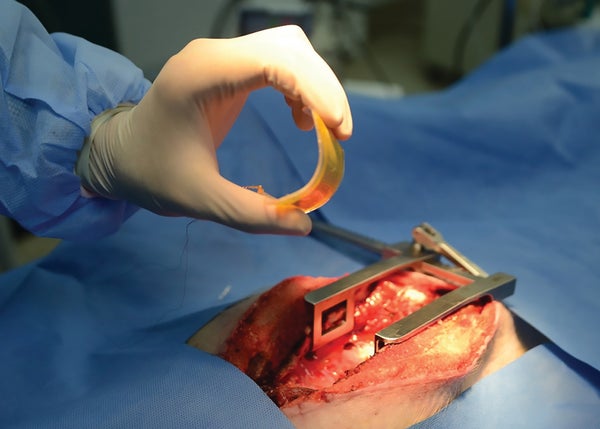
Zhou Li of the Beijing Institute of Nanoenergy and Nanosystems and Zhong Lin Wang of the Georgia Institute of Technology and their colleagues implanted their device in two adult male pigs. In the first animal (which had a healthy heart), the team tested how well the generator harvested energy; it powered the pacemaker for a total of nearly three and a half hours. The pig’s heart generated more than enough energy to power a human version of the pacemaker, the scientists reported in April in Nature Communications. In the second pig, they induced an irregular heartbeat (arrhythmia) to test the pacemaker’s therapeutic function. When the device—which had been charged by the pig’s heart for more than an hour—was turned on, the animal’s heartbeats promptly became regular and remained so even after it was turned off.
On supporting science journalism
If you're enjoying this article, consider supporting our award-winning journalism by subscribing. By purchasing a subscription you are helping to ensure the future of impactful stories about the discoveries and ideas shaping our world today.
Human testing is unlikely in the near future because the device’s size, safety and efficiency must still be optimized. “The technology described is a significant achievement,” says Patrick Wolf, a biomedical engineer at Duke University, who was not involved in the study. But he cautions that the size and efficiency hurdles are significant, and the pacemaker’s effectiveness in a less dynamic, diseased heart is yet to be determined.
Another drawback is that the unit must be attached directly to the heart’s surface and could interfere with the organ’s functions. A group at Dartmouth College and the University of Texas at San Antonio previously designed a pacemaker that instead harnesses kinetic energy from its own lead wire, which moves when the heart pulses. The team is currently testing it in dogs.
“The development of these battery-free technologies will revolutionize implantable devices,” says Ramses Martinez, a researcher in industrial and biomedical engineering at Purdue University, who was not involved in either study. “Soon traditional rigid implants will evolve into conformable systems capable of harvesting the energy they need to function from the patient.”