
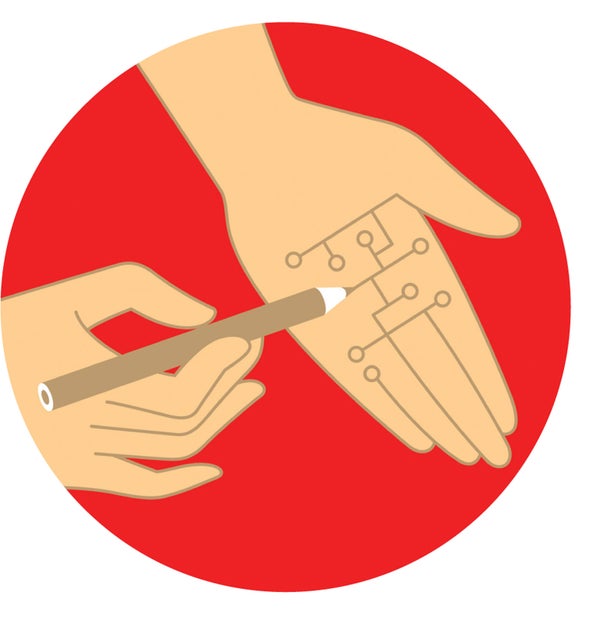
A handful of stencils and three pens sound like materials for a child's art project. But researchers have now used these tools to draw functional health monitors directly on human skin.
Wearable sensor technology, which helps doctors check a variety of health indicators, has in recent years advanced from bulky devices to flexible patches that stick to people like temporary tattoos. These prefabricated sensors can be expensive, however. They also tend to follow skin contours imperfectly, making them sensitive to the wearer's motion. Researchers say that a new drawn-on-skin electronics system, described in Nature Communications, could offer a solution to both problems.
A team led by biomedical engineer Faheem Ershad of the University of Houston first developed a conductive ink using silver flakes in a polymer solution that is safe to use on human skin. The researchers loaded the ink into modified ballpoint pens, then placed a stencil made of tape and film on a volunteer and traced within it to draw the requisite circuitry. “It's like a kindergartener learning how to draw shapes,” Ershad says. “It's really that simple.” Within five minutes the ink dried to create a working sensor. The researchers then taped on a standard electrical lead to provide power and transmit data to a computer.
On supporting science journalism
If you're enjoying this article, consider supporting our award-winning journalism by subscribing. By purchasing a subscription you are helping to ensure the future of impactful stories about the discoveries and ideas shaping our world today.
Using just this type of ink, the team measured skin hydration and the electrical activity of heart and skeletal muscles. Because the sensor conformed perfectly to the skin, wearers could walk around without jarring it and thereby reducing data quality. The ink resisted sweat and rubbing but was easily removed with a wet paper towel and soap. “It's robust and very easily applied on any body part,” says Dmitry Kireev, who researches wearable bioelectronics at the University of Texas at Austin and was not involved in the study. “It's a very elegant solution.”
For more complex devices, Ershad's team used two additional inks: one served as a semiconductor, and the other acted as a dielectric (a type of insulator). Drawing different layers with each ink, the researchers crafted temperature and strain sensors on a sheet of skinlike silicone. “The authors already demonstrated many very attractive applications,” says Zheng Yan, a biomedical engineer at the University of Missouri, who was not involved in the new research. Yan and his colleagues have developed similar technology using pencils and paper, but their method is limited to passive conductors that cannot introduce energy into a circuit. By drawing active electronics such as transistors, which can function as switches or amplifiers, Ershad says that he hopes to create sophisticated sensors to detect health indicators ranging from compounds in sweat to the brain's electrical activity.
The researchers plan to eventually make their sensors truly wireless by incorporating more advanced ink-based circuits. After that achievement, they say, people could use affordable kits of stencils and pens to monitor their own health at home.
