
A concentration of one part per billion is like a pinch of salt in 10 tons of potato chips—and scientists can now find radioactive particles at concentrations millions of times smaller. In the Journal of Analytical Atomic Spectrometry, researchers describe successfully detecting radioactive uranium and thorium hiding among something like a million billion other atoms.
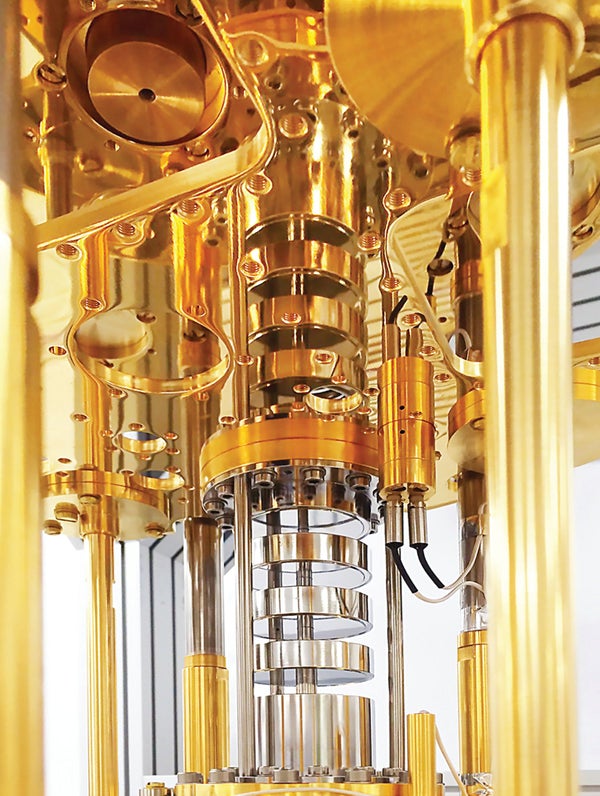
The ability to spot these tiny amounts of radioactive elements, which occur naturally in metals such as gold that are often used in laboratory instruments, could have big consequences for particle physics. Radioactive traces limit sensitivity in detectors searching for exotic particles, including those that might make up dark matter; a minuscule radioactive impurity inside a detector can be mistaken for a particle's signature, throwing off the entire experiment.
“Before we do anything else, we need the cleanest possible materials,” says Michelle Dolinski, a particle physicist at Drexel University and the Enriched Xenon Observatory, who was not involved with the study. Her work on rare particle searches intertwines with that of chemists tracing radioactivity.
On supporting science journalism
If you're enjoying this article, consider supporting our award-winning journalism by subscribing. By purchasing a subscription you are helping to ensure the future of impactful stories about the discoveries and ideas shaping our world today.
“Physics needs really push the chemistry,” says Pacific Northwest National Laboratory (PNNL) chemist and study co-author Eric Hoppe. He and the other researchers pinpointed small concentrations of radioactive thorium and uranium in metallic samples by using a mass spectrometer, which separates particles based on their mass.
First, the scientists had to make radioactive elements more massive than a metal's other atoms, explains lead author Khadouja Harouaka, also a chemist at PNNL. To do so, they heated a metallic sample until it became very reactive and pushed it into a chamber full of oxygen. Any thorium or uranium in the sample then combined with the oxygen to form molecules massive enough to stand out in spectrometer data. Scientists next counted these oxidized radioactive particles and calculated their original concentration— a value that suggests how much radiation the material would introduce to physics experiments.
Whereas many previously developed particle-detection methods must be modified for each specific metal, the new technique always uses the same heating and oxidizing steps. “The whole palette of materials is opening up,” Hoppe says.
Material options are critical for the design of particle detectors, says Priscilla Cushman, a physicist at the University of Minnesota and the Super Cryogenic Dark Matter Search experiment, who was not involved with the study. “There are so many little pieces of [a dark matter] experiment that have different functions,” she says. “The materials that are used for electrical or thermal connections, or even insulation, all those have to be radio pure.” Every new metal examined can be considered for detector components. Hoppe is also looking ahead: “We're constantly trying to knock down all of the suspect [radioactive] materials. This work is a nice step forward.”