
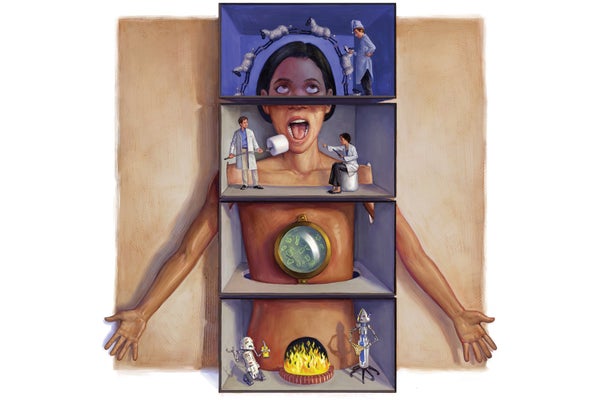
As Cleveland Cavaliers guard J. R. Smith has probably heard a few times at this point, you have to be solid in the fundamentals. For a basketball player, some of the fundamentals are dribbling, shooting and, as Smith learned the hard way, knowing the correct score with seconds to play in the first game of the NBA Finals. For the rest of us (who blissfully do dumb things without attracting worldwide attention), the major fundamentals include sleeping, eating, sex and eliminating. Fortunately, new scientific research has made key discoveries all these areas.
Let's start with what would have been great news for Macbeth, who admits in the play that he has concerns about getting a decent night's sleep. He's all “Sleep no more!” and “Macbeth does murder sleep.” Sounds a lot like modern life, doesn't it? Sure, he's racked with guilt over taking the crown, whereas we're up late binge-watching The Crown. But either way, a new study finds that lost sleep may once again be found.
Insufficient sleep is a big deal. People die early from it. One of the latest reports, “Sleep Duration and Mortality—Does Weekend Sleep Matter?” (published May 22 online in the Journal of Sleep Research), found that weekend bonus slumber wards off the deadly effects of weekday sleep deprivation. Of course, Macbeth never got a chance to catch up on his sleep tomorrow and tomorrow and tomorrow.
On supporting science journalism
If you're enjoying this article, consider supporting our award-winning journalism by subscribing. By purchasing a subscription you are helping to ensure the future of impactful stories about the discoveries and ideas shaping our world today.
Over in the eating realm, a study calls into question the meaning of the famous marshmallow delayed-gratification test. The oft-cited analysis found a strong correlation between a kid's ability to hold off eating a marshmallow (with the promise of a second marshmallow for doing so) with that kid's later achievements and behavior.
The new study, “Revisiting the Marshmallow Test: A Conceptual Replication Investigating Links between Early Delay of Gratification and Later Outcomes,” released May 25 online in Psychological Science, tested 10 times as many youngsters as did the original research. And it found a much smaller association between delaying gratification and how the children turned out. The work also discovered a connection between higher family income and short-term self-control. Perhaps the rich kids showed up for the test stuffed.
In news that won't surprise Westworld viewers, here's a Washington Post headline: “New Report Finds No Evidence That Having Sex with Robots Is Healthy.” The paper, “I, Sex Robot: The Health Implications of the Sex Robot Industry,” appeared online June 4 in BMJ Sexual & Reproductive Health. The authors note, “We found no reports of primary data relating to health aspects of the use of sex robots.” Thus, any health claims made by manufacturers of sexbots—such as safer sex, therapeutic potential or sex offender treatment—are just wishful thinking.
The write-up also states: “The UK General Medical Council and medical defence organisations have not issued any guidance, but doctors might be advised to avoid using sexbots themselves, given police interest, prosecutions, and the potential negative impact on public trust.” Or as Austin Powers, no stranger to sexbots, said, “Oh, behave.”
Bringing up the rear, Clostridium difficile bacterial infections range from exhausting—numerous daily bouts of diarrhea—to life-threatening. (A possible complication is the one with the supervillain name “toxic megacolon.”) In recent years so-called fecal transplants have proved to be an effective therapy against stubborn C. diff infections. As I wrote in this space five years ago, “the procedure involves the insertion of a small, diluted sample of stool from a donor into the colon of a recipient.... The swap imports a healthy community of bacteria.”
A letter published online on June 2 in the New England Journal of Medicine entitled “Fecal Microbiota Transplantation for Primary Clostridium difficile Infection” describes the latest trial to once again find that another person's poop can get patients out of this pickle. It would thus seem that the frequently given advice to not take any crap from anyone has an important medical exception.