
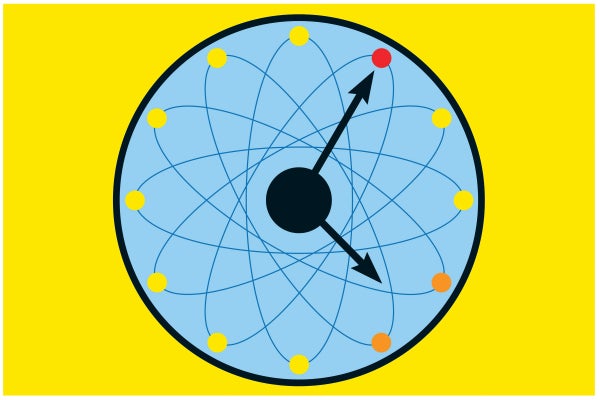
From satellite navigation to GPS, the world runs on ultraprecise timekeeping, usually based on atomic clocks. These devices use energy sources, such as lasers tuned to specific frequencies, to excite electrons orbiting atomic nuclei. The electrons jump or “transition” to a higher energy level before falling back down to a lower one at rapid, regular time intervals—an atomic clock's “tick.”
But even atomic clocks aren't perfect, because environmental factors can affect how electrons bounce. As our technological tools require ever more precision, physicists are devising a possible solution: move timekeeping inside the nucleus, which is insulated from such interference, by exciting protons and neutrons instead of electrons. Because protons and neutrons are relatively dense, a “nuclear clock” would require far more powerful tuned lasers—and a very particular kind of atom. Now breakthrough measurements of the isotope thorium 229, published recently in Nature, suggest that a practical nuclear clock may finally be within reach.
Whereas today's best atomic clocks lose one second every 100 million years, nuclear clocks would lose one second every 31.7 billion years (which is more than twice the age of the universe), explains the study's lead author, Sandro Kraemer. This enhanced precision could lead to advances in timekeeping, nuclear physics, and the quantum sensor technology used for satellite navigation and telecommunications. “It will instantly improve nuclear physics measurements by a [factor of a] trillion to a quadrillion,” says José R. Crespo López-Urrutia, a scientist at Germany's Max Planck Institute for Nuclear Physics, who was not involved with the new measurements.
On supporting science journalism
If you're enjoying this article, consider supporting our award-winning journalism by subscribing. By purchasing a subscription you are helping to ensure the future of impactful stories about the discoveries and ideas shaping our world today.
In 2003 physicists first suggested that a synthetic isotope called thorium 229 could be the key to nuclear timekeeping. Theoretically, thorium 229's nuclear particles could transition into an excited state with a uniquely low amount of energy, making it the only isotope that current laser technology could feasibly excite for a nuclear clock. “Most [elements'] nuclear transitions have very large energies in the range of thousands or millions of electron volts,” which is beyond the capabilities of even state-of-the-art lasers, says Adriana Palffy, a physicist at the University of Würzburg in Germany, who also was not involved in the new work.
In the study, a team of physicists at CERN's nuclear physics facility, ISOLDE, spotted and measured thorium 229's nuclear transition for the first time. At 8.3 electron volts, the transition would be small enough to be triggered by a specially tuned laser. Physicists are now developing lasers to make the thorium clock tick, says Piet Van Duppen, the ISOLDE team's spokesperson and a professor at the Institute for Nuclear and Radiation Physics at KU Leuven in Belgium. “Once the resonance [between thorium 229 and these new lasers] is observed,” Van Duppen says, “we will make a major leap forward.”