
A cutting-edge NASA satellite has provided one of the most detailed looks yet at glaciers in Greenland and Antarctica. The findings are clearer than ever: Both ice sheets are losing billions of tons of mass into the ocean each year, contributing significantly to global sea-level rise.
The results were published yesterday in the journal Science by a team of researchers from around the country, led by Ben Smith of the University of Washington. They’re among the first published findings from the ICESat-2 mission, a NASA satellite that can measure changes in the height of the Earth’s ice sheets and the thickness of polar sea ice.
Launched in September 2018, the mission was a much-anticipated follow-up to a previous ICESat mission, which concluded in 2009. Equipped with a set of high-tech laser instruments, ICESat-2 is far more sensitive than the original mission—able to make fine observations of changes in the Earth’s surface.
On supporting science journalism
If you're enjoying this article, consider supporting our award-winning journalism by subscribing. By purchasing a subscription you are helping to ensure the future of impactful stories about the discoveries and ideas shaping our world today.
Now, those observations are giving scientists new insight into the plight of the world’s largest ice sheets.
Since 2003, the combined ice loss from Greenland and Antarctica has contributed more than a half-inch to global sea-level rise. While some sections of the ice sheets are actually gaining mass in the form of accumulating snow, those gains are outweighed by losses from melting ice and crumbling glaciers in other areas.
Previous studies have come to similar conclusions. But the new data gives scientists a closer look at exactly where those losses are coming from—and what’s causing them.
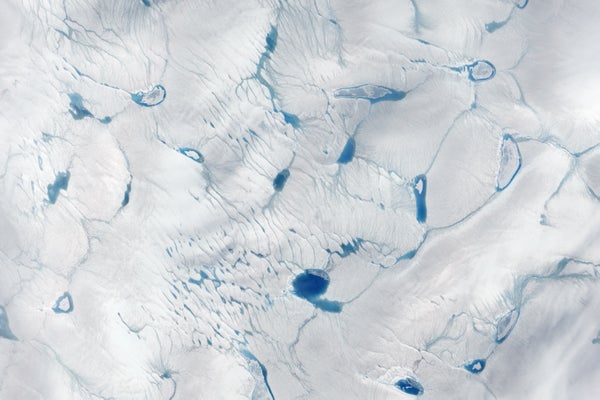
In Greenland, ice loss mainly occurs in the form of surface melting. The top of the ice sheet warms and melts, and the water runs off into the ocean.
While Greenland saw some modest gains in mass near the center of the ice sheet, it suffered far more serious losses in other areas—especially the northwest and southeast regions.
Antarctica also gained mass in some areas, mainly East Antarctica. But these gains were outweighed by losses in West Antarctica and the Antarctic Peninsula.
In contrast to Greenland, crumbling glaciers are a more important factor when it comes to ice loss in Antarctica. This is when chunks of ice pour from the edge of the ice sheet into the sea.
Glaciers are often stabilized by ice shelves—tongues of ice that jut out from the edge of the ice sheet into the ocean. If an ice shelf weakens or breaks, it can cause ice to pour from the glacier into the ocean at a faster rate.
In recent years, scientists have noticed that warm ocean currents are causing some Antarctic ice shelves to melt from the bottom up, making them thinner and weaker.
Since ice shelves are already technically resting in the water, their own melting doesn’t actually contribute to sea-level rise. But if the glaciers behind them begin to flow and crumble at faster rates as the shelf weakens, that’s a concern.
The new data indicates that thinning ice shelves are a growing cause of ice loss from Antarctic glaciers. In West Antarctica, for instance—the fastest-melting part of the Antarctic ice sheet—melting ice shelves accounted for nearly a third of the region’s total mass loss.
Meanwhile, grounded ice—the ice that actually contributes to sea-level rise—is still pouring into the ocean by the billions of tons. Greenland is losing around 200 billion tons of grounded ice each year, and Antarctica more than 100 billion.
Reprinted from Climatewire with permission from E&E News. E&E provides daily coverage of essential energy and environmental news at www.eenews.net.
