
If somebody yells, “Snake!” are you more likely to jump back in fright or say, “Ooh, where?” Fear of snakes (ophidiophobia) is one of the most common phobias. Plenty of species are venomous, and in some religious traditions snakes are the embodiment of evil. It's no wonder they're unpopular. But advocates using social media are helping people identify and learn to live with snakes and even become fascinated with them. Author Emily Willingham introduces a cast of funny and charming converts who have gone from “Eek!” to “Ooh!”
One classic bit of writing advice is to use quotations to convey people's character or emotion. The “Saving Snakes” story does that beautifully, making the snake lovers seem so human and real, like people you just swapped stories with at a picnic. We get to know another kind of character as researcher Almira Osmanovic Thunström shares a conversation she had with an artificial intelligence named GPT-3. She asked the AI to write up a scientific paper about itself, which raises all kinds of intriguing questions about scientific collaborations and publishing ethics and how easily we anthropomorphize AIs.
Weather forecasting has gotten steadily more accurate and farseeing over the past few decades, one of the many ways that science saves lives. Research meteorologist F. Martin Ralph discusses how he and his colleagues have come up with a new way to forecast and rate atmospheric rivers. These powerful storms form over the ocean and can be 2,000 miles long and 500 miles wide and cause devastating flooding, as happened in Yellowstone National Park earlier this year. The new atmospheric river scale may become as important and someday as well known as the Richter scale for earthquakes or the Saffir-Simpson scale for rating hurricanes.
On supporting science journalism
If you're enjoying this article, consider supporting our award-winning journalism by subscribing. By purchasing a subscription you are helping to ensure the future of impactful stories about the discoveries and ideas shaping our world today.
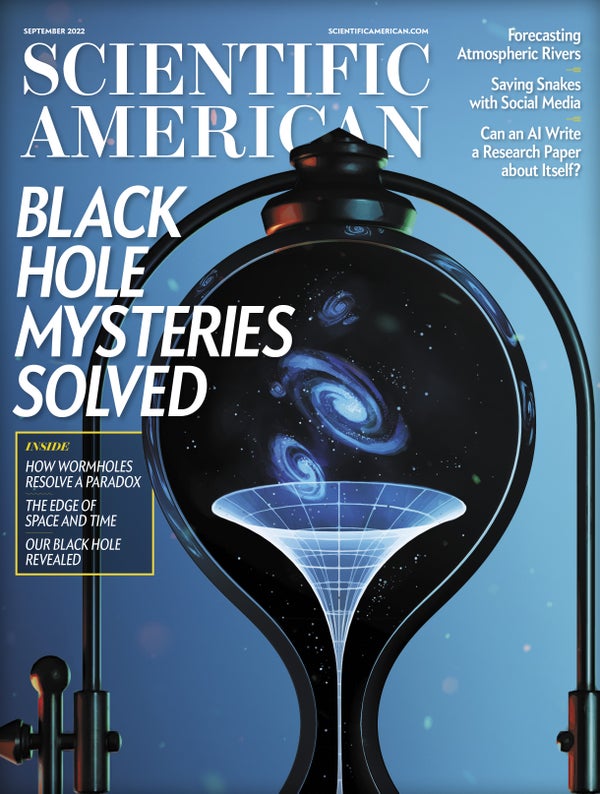
Black holes have been a problem for physics for more than 60 years. They are so dense that their gravity permanently captures everything that comes near them, even light. As Scientific American contributing editor George Musser explains, this seems to violate a basic property of physics: that everything, in theory, is reversible and that information is never lost. Now physicists have come up with an explanation for how information can be preserved—or, actually, a few explanations. They disagree with one another (being physicists) on the details, but the solutions are all delightfully mind-bending and involve Hawking radiation, entangled quantum particles and wormholes (seriously).
Our special report on this exciting time in science includes a how-we-did-it story from physicist Ahmed Almheiri describing how he and his colleagues arrived at an answer to the paradox. Physicist Edgar Shaghoulian shows how the advances in understanding the edges of black holes have led to advances in understanding the edges of our universe. And a few months ago scientists revealed the first image of our very own black hole, Sagittarius A*, the black hole at the center of the Milky Way. Seth Fletcher, who runs Scientific American's features department (and wrote a book about the search for Sgr A*), explores what we've learned about it so far and what questions astronomers are working on now.
Space and physics editor Clara Moskowitz created the special package with a lot of enthusiasm from the rest of the staff. We hope you enjoy it and think about these stories of discovery next time you look up at the night sky.