
SpaceX CEO Elon Musk likes reusability. With 16 successful rocket landings under its belt, along with two reused rockets and one reused Dragon spacecraft, Musk's rocket company has made giant leaps in reusable booster technology for sure.
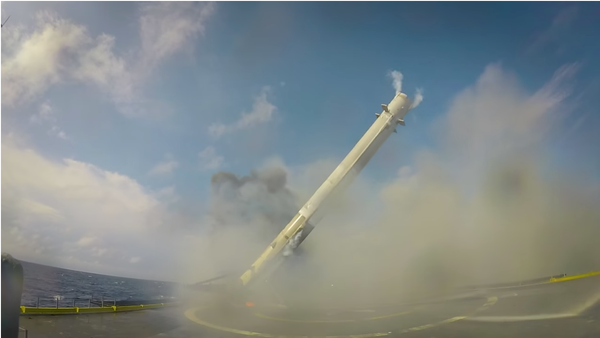
But an amazing new video from the company, which Musk has touted as a mere "blooper reel," shows just how hard it is to launch rockets into space and land them safely again. Musk posted the video—called "How Not to Land a Rocket"—on Twitter today (Sept. 14). SpaceX's most recent rocket landing occurred Sept. 6 after the launch of an Air Force X-37B space plane.
"Long road to reusabity of Falcon 9 primary boost stage," Musk wrote on Twitter. "When upper stage & fairing also reusable, costs will drop by a factor >100." [Watch a Supercut of 5 Amazing SpaceX Rocket Landings!]
On supporting science journalism
If you're enjoying this article, consider supporting our award-winning journalism by subscribing. By purchasing a subscription you are helping to ensure the future of impactful stories about the discoveries and ideas shaping our world today.
He teased the video's arrival last week: "Putting together SpaceX rocket landing blooper reel. We messed up a lot before it finally worked, but there's some epic explosion footage."
"Epic" is right.
The video is set to a soundtrack of John Philip Sousa's "The Liberty Bell" march (which also served as the theme song for "Monty Python's Flying Circus"). It shows a series of rocket-landing fails dating back to 2013 as SpaceX tried repeatedly to perfect the technology needed to land the first stage of its two-stage Falcon 9 rockets back on Earth.
The early Falcon 9 booster landing attempts were over the open ocean, with the rockets either slamming into the sea hard, or hovering over the waves before tipping over. Another clip shows the dramatic explosion of SpaceX's prototype first stage for landings, the Falcon 9 Reusable (or F9R). That booster exploded in August 2014 over McGregor, Texas, when an engine sensor failed.
In the new video, Musk is seen touring the F9R wreckage. "Rocket is fine," a caption reads. "It's just a scratch."
SpaceX's next rocket failures occurred at sea as the company tried to land the Falcon 9 booster on a drone ship. In September 2014, a rocket ran out of liquid oxygen before touchdown, and crashed. In January 2015, another booster ran out of hydraulic fluid and made a spectacular nighttime crash into the drone ship.
"Well, technically it did land," a video caption reads. "Just not in one piece."
A sticky throttle valve doomed a rocket-landing try in April 2015. The booster gets so close to a successful landing, then falls over and explodes.
"Look, that's not an explosion … it's just a rapid unscheduled disassembly," the video states.
SpaceX achieved its first successful rocket landing in December 2015, but the blooper video initially skips that milestone. Instead, it skips straight to January 2016, when a landing leg collapsed during touchdown, causing the Falcon 9 booster to tip over and explode.
In March 2016, a landing engine burn failed, and the booster slammed into its landing platform.
"The course of true love never did run smooth," a video caption reads.
Then comes a strange sight. During a May 2016 rocket landing, the booster can be seen hopping about on its drone ship. SpaceX attributes the weird rocket dance to a radar glitch that damaged the landing legs. The booster had an obvious tilt when the drone ship finally reached its port in Cape Canaveral, Florida.
A June 2016 rocket landing failed when the booster ran out of propellant.
Only after the June crash does the new SpaceX video return to its first successful rocket landing, in December 2015. That mission launched a Dragon cargo ship for NASA, and then returned to Earth to make a smooth landing at SpaceX's Landing Zone 1 pad at Cape Canaveral Air Force Station.
SpaceX made its first successful drone ship landing in April 2016.
"You are my everything," the SpaceX video states.
SpaceX and Musk have long pursued reusable rockets to lower the cost of spaceflight. It's a core part of the company's goal to colonize Mars with giant reusable spaceships.
SpaceX successfully launched two used Falcon 9 rockets earlier this year. The company has also seen two other failures. A Falcon 9 rocket failed in June 2015 during a Dragon cargo ship launch for NASA. In September 2016, a rocket exploded on SpaceX's launchpad at Cape Canaveral Air Force Station ahead of a preflight test.
Earlier this year, Musk said SpaceX is studying the potential for a completely reusable Falcon 9 rocket. That would mean reusing the rocket's upper stage, as well as its protective payload fairing (the nose cone). The fairing alone costs about $5 million, Musk has said.
SpaceX is also building a much larger rocket, the Falcon Heavy, which will consist of three Falcon 9 boosters for its first stage. All three of those rockets are designed to land after launch, Musk has said.
The first Falcon Heavy test flight is expected to launch in November.
EDITOR'S RECOMMENDATIONS
In Photos: SpaceX Launches, Lands 1st Reused Falcon 9 Rocket
Relive SpaceX's Return-to-Flight Falcon 9 Launch with These Awesome Pictures
Copyright 2017 SPACE.com, a Purch company. All rights reserved. This material may not be published, broadcast, rewritten or redistributed.