
WASHINGTON—In the Obama administration’s final days, the National Cancer Institute is establishing an ambitious new program designed to allow scientists to more quickly access new drugs and compounds for novel research.
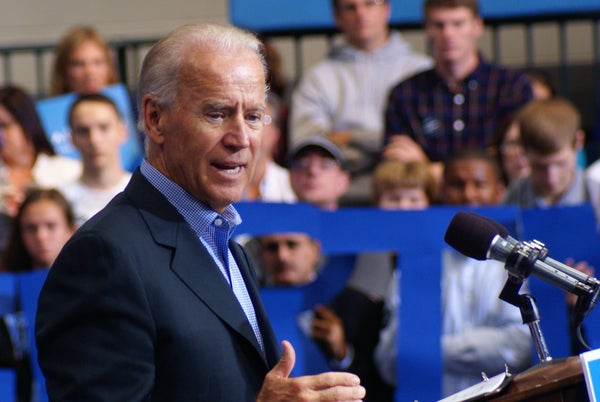
One of the last achievements of Vice President Joe Biden’s cancer moonshot initiative before he leaves office, the program was unveiled Wednesday and will begin as an agreement between the institute and six drug companies.
The hope is that the arrangement, in which NCI will act as an intermediary between outside researchers and drug makers, will make it easier for scientists to pursue new combination therapies for cancer, which are widely seen as one of the most promising avenues for better cancer treatment.
On supporting science journalism
If you're enjoying this article, consider supporting our award-winning journalism by subscribing. By purchasing a subscription you are helping to ensure the future of impactful stories about the discoveries and ideas shaping our world today.
Currently, if investigators want to combine two therapies made by different companies in a new preclinical or clinical trial study, they must negotiate a contract on their own with the firms. Data and intellectual property rights, along with many other details, must be worked out before the study can start.
“It’s very difficult for investigators or physicians to be able to get access to different types of drugs,” said Kim Harrow, vice president of clinical operations at Xcovery, a firm working on lung cancer therapies and participating in the program.
Harrow said she was aware of proposed studies that had been stuck in such negotiations for two years or more. Investigators might not be equipped to handle those negotiations, or companies might not have the bandwidth to negotiate individually with different researchers.
“I think, particularly for the investigator-initiated trials, it can be much more difficult,” said Dr. Christopher Slapak, vice president of early-phase clinical research at Eli Lilly and Co. “It never rises high enough in the company’s priorities for all the work they have to do.”
Under this new arrangement, known as the NCI Formulary, the agency will act as an intermediary between scientists at NCI-designated research centers across the country and drug makers. Companies agree to review proposed studies within 60 days, and there will be set standards for data and intellectual property rights.
At its start, six companies—Bristol-Myers Squibb, Eli Lilly, Genentech, Kyowa Kirin, Loxo Oncology, and Xcovery—are participating in the program, making 15 agents available. NCI officials say they are currently negotiating with a “substantial” number of other companies to add more therapies to the formulary.
That will be perhaps the biggest challenge for the initiative: Can it prove that the process works smoothly enough that other companies see a benefit to participating?
“It’s got to work well, it’s got to work fast, it’s got to be frictionless,” Dr. George Demetri, a bone oncologist at the Dana-Farber Cancer Institute and member of the American Association for Cancer Research, told STAT.
For the project to reach its full potential, more companies and more agents must be introduced into the system, industry officials say.
“If we can really get traction with this, and get some drugs there in the formulary, I think this could be great for patients,” said Dr. Julie Hambleton, head of US Medical at Bristol-Myers Squibb. “But it, of course, will depend on what companies come and engage in this and what drugs they put in this formulary.”
It could also allow researchers to test combinations for rare cancers and indications that the companies on their own might not be interested in pursuing because they’re not “as lucrative,” said Xcovery’s Harrow.
“There is a huge role for investigator-initiated research, being the engine of discovery for new compounds and new signals,” said Jeff Allen, president and CEO of the Friends of Cancer Research, a nonprofit organization. “That’s where this plays a really unique role in the ecosystem of R&D. The larger the formulary can become, the more potential that it has.”
For now, some in the industry seem to be waiting to see the early returns before adding their compounds and therapies to the mix.
“I think there’s also a bit of a ‘let’s see how this goes,’” said Lilly’s Slapak, “and to see the quality of the trials, see the quality of data that comes out.”
“Success breeds success,” he added.
Republished with permission from STAT. This article originally appeared on January 11, 2017