
Do you remember learning about New England witch trials for the first time, maybe in an elementary school history class? I remember being horrified and incredulous—they threw you in a river? And if you drowned, that meant you were innocent? Witch trials seemed like an episode from a fairy tale, something that happened unimaginably long ago during a dark, mean and superstitious age. Well, the darkness and meanness and superstitions have persisted. QAnon conspiracists claim that U.S. society is run by Satan-worshipping child abusers—witches, basically. In many countries today, women (and sometimes men or children) are still accused of using magic to cause accidents or other trouble. Their neighbors, justifying their violence by claiming they're punishing a witch, torture and kill them. It all seems so nonsensical and awful, but as historian Silvia Federici and writer Alice Markham-Cantor discuss, throughout history certain kinds of economic upheaval have increased the risk that witchcraft accusations will erupt and spread.
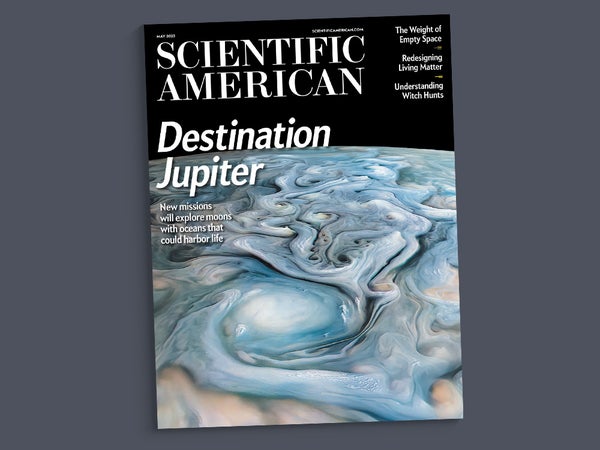
Let's mentally leave this planet for a moment. What's your favorite planet that isn't Earth? Many of the scientists, journalists and science fans I know are passionately Team Saturn or Team Jupiter. Our cover package makes a great case for Jupiter and its moons being the most awesome places in our solar system. We're about to learn a lot more about them, as journalist Jonathan O'Callaghan tells us, thanks to two new missions: JUICE and Clipper. They'll evaluate Europa and Ganymede for potential habitability. Scientific American contributor Rebecca Boyle and graphic artist Juan Velasco depict the interiors of Jupiter's most intriguing moons and where they might have heat and oceans. We end the report with some gorgeous images of Jupiter that were created by citizen scientists.
The “worst theoretical prediction in the history of physics” has to do with the amount of energy in a vacuum. Researchers have two ways of calculating the answer ... but the results are wildly divergent. Now an experiment, named Archimedes, aims to get the best data yet to determine the weight of nothing. Theoretical physicist Manon Bischoff, an editor at Spektrum, the German-language partner publication of Scientific American, takes us deep into a tunnel in Sardinia to show how the delicate experiment will be run and explain the high stakes.
On supporting science journalism
If you're enjoying this article, consider supporting our award-winning journalism by subscribing. By purchasing a subscription you are helping to ensure the future of impactful stories about the discoveries and ideas shaping our world today.
Transportation is the largest source of greenhouse gases in the U.S. Car emissions have lessened dramatically over the decades, decreasing smog and lead pollution. New technologies for electric vehicles, hybrids and highly fuel-efficient cars can help. But one of the simplest solutions for improving transportation—for our climate, safety and quality of life—is more and better buses. Climate journalist Kendra Pierre-Louis makes a great case for why and how more areas should enhance their bus systems.
An emerging field called synthetic morphology experiments with the structure and function of living things. As author and former Nature editor Philip Ball describes, the goal is to understand how development works naturally while making new types of life-forms that have useful functions. Scientists hope to incorporate living tissue cultures, some of which are genetically engineered, to create “superorgans” or replacement parts—even life-forms we can only imagine.