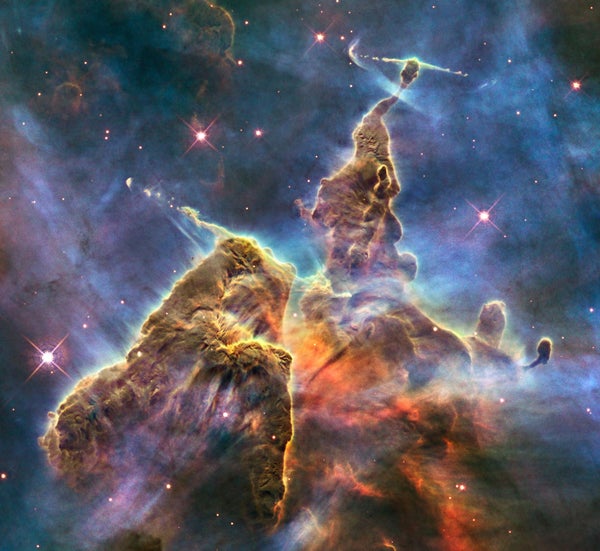
New view of dusty spires marks Hubble's 20th birthday
The Hubble Space Telescope passed its 20th anniversary of reaching orbit on April 24, an occasion marked with the release of a new image from the venerable observatory, depicting a star-forming region of the Milky Way some 7,500 light-years away called the Carina Nebula.
NASA, ESA, and M. Livio and the Hubble 20th Anniversary Team (STScI)
Join Our Community of Science Lovers!
On supporting science journalism
If you're enjoying this article, consider supporting our award-winning journalism by subscribing. By purchasing a subscription you are helping to ensure the future of impactful stories about the discoveries and ideas shaping our world today.
The Hubble Space Telescope passed its 20th anniversary of reaching orbit on April 24, an occasion marked with the release of a new image from the venerable observatory, depicting a star-forming region of the Milky Way some 7,500 light-years away called the Carina Nebula.
The pillars in Hubble's new image, which was captured by the telescope in February, are dusty plumes of gas undergoing erosion from the radiation and stellar winds of young, nearby stars. According to a NASA press release, the main pillar is three light-years high, although this photograph depicts only its top segment.
The new release recalls Hubble's famous 1995 image, known as "The Pillars of Creation," showing similar features in the Eagle Nebula. But whereas that image came from Hubble's old Wide Field Planetary Camera 2 (WFPC2), the photograph of the Carina spires was produced by the more advanced Wide Field Camera 3 (WFC3). Spacewalking astronauts swapped in WFC3 for its aging predecessor during the final scheduled servicing mission to Hubble in May 2009.
Subscribe to Support Independent Journalism
Great science journalism requires human expertise, time, effort and creativity. And it costs money. That’s why I and the journalists here at Scientific American hope you’ll join our community.
When you subscribe, you are supporting staff and freelance journalists who are passionate about telling science stories that are true, important and compelling. Our editors and reporters are often experts in their fields, which means they understand the nuances of big discoveries and can untangle the breakthroughs from the hype. With a subscription, you are also supporting rigorous fact-checking to ensure the words we publish are precise and accurate. And you’re supporting original illustrations, graphics and photos that bring you closer to an advanced laboratory, an ice sheet in Antarctica or a space mission in orbit. You’re helping us craft other types of high-quality journalism as well: Our newsletters are carefully written, edited and curated by staffers you have or will come to know and love. Our Science Quickly podcast is based on original reporting, collaboration with editors and scientists and exacting production.
Subscriptions keep this engine running so we can continue to deliver thoughtful, rigorous and independent science journalism to you. In an era of viral misinformation, this work is crucial. If you value what we do, I hope you’ll consider joining us as a subscriber
Thank you,
Jeanna Bryner, Editor in Chief, Scientific American