New Views across the Galaxy

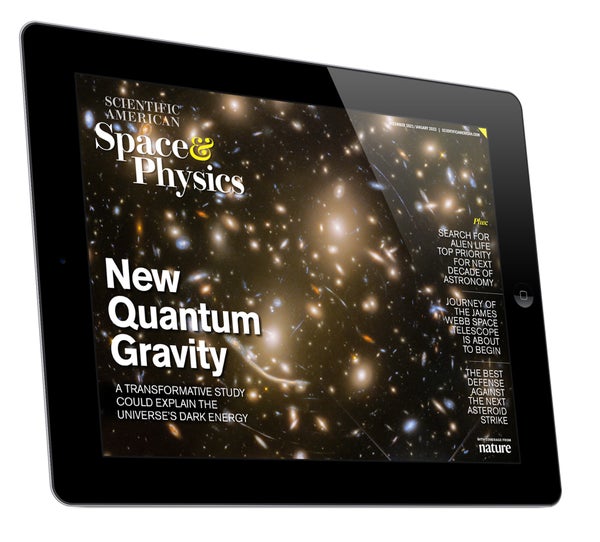
Scientific American Space & Physics, December 2021

Join Our Community of Science Lovers!


On supporting science journalism

If you're enjoying this article, consider supporting our award-winning journalism by subscribing. By purchasing a subscription you are helping to ensure the future of impactful stories about the discoveries and ideas shaping our world today.


At a talk in mid-November hosted by Pioneer Works in Red Hook, Brooklyn, astrophysicists Rebecca Oppenheimer and Natalie Batalha speculated on the chances that life exists on exoplanets somewhere in our galaxy. Most likely, Oppenheimer said, life is ubiquitous in the universe, but it might not take the form that we imagine. Of the thousands of exoplanets already detected, our telescopic abilities limit the level of detail we can make out, even in the nearest planetary systems. Space is just really big, and other stars and their planets are far away. As senior editor for space and physics Lee Billings writes in this issue, the near-term big goal of astronomy in this country is to devise the next-generation telescope—essentially an upgraded, supersize version of the Hubble Telescope. Likely to be completed in the 2040s, the new endeavor would scout for habitable planets in the galaxy and for alien life (see “Hunt for Alien Life Tops Next- Gen Wish List for U.S. Astronomy”).

When we look into the night sky, Batalha said, we aren’t looking at individual stars, but instead each speck of light is a planetary system and therefore a candidate for housing life. Astronomers indeed must devise grand plans to make progress while looking off-Earth. To that end, another telescope—with a price tag of $10 billion—is set to launch this December, as writer Nikk Ogasa reports (see “The Nail-Biting Journey of NASA’s James Webb Space Telescope Is about to Begin”). Yes, space is really big, but we have the ambition to see across the miles.

Andrea Gawrylewski is chief newsletter editor at Scientific American. She writes the daily Today in Science newsletter and oversees all other newsletters at the magazine. In addition, she manages all special editions and in the past was the editor for Scientific American Mind, Scientific American Space & Physics and Scientific American Health & Medicine. Gawrylewski got her start in journalism at the Scientist magazine, where she was a features writer and editor for "hot" research papers in the life sciences. She spent more than six years in educational publishing, editing books for higher education in biology, environmental science and nutrition. She holds a master's degree in earth science and a master's degree in journalism, both from Columbia University, home of the Pulitzer Prize.

More by Andrea Gawrylewski
SA Space & Physics Vol 4 Issue 6This article was published with the title “New Views across the Galaxy” in SA Space & Physics Vol. 4 No. 6 ()
doi:10.1038/scientificamerican122021-6BvdW6vJKd5YlPkm4Ci3Bz

It’s Time to Stand Up for Science

If you enjoyed this article, I’d like to ask for your support. Scientific American has served as an advocate for science and industry for 180 years, and right now may be the most critical moment in that two-century history.

I’ve been a Scientific American subscriber since I was 12 years old, and it helped shape the way I look at the world. SciAm always educates and delights me, and inspires a sense of awe for our vast, beautiful universe. I hope it does that for you, too.

If you subscribe to Scientific American, you help ensure that our coverage is centered on meaningful research and discovery; that we have the resources to report on the decisions that threaten labs across the U.S.; and that we support both budding and working scientists at a time when the value of science itself too often goes unrecognized.

In return, you get essential news, captivating podcasts, brilliant infographics, can't-miss newsletters, must-watch videos, challenging games, and the science world's best writing and reporting. You can even gift someone a subscription.

There has never been a more important time for us to stand up and show why science matters. I hope you’ll support us in that mission.

Thank you,

David M. Ewalt, Editor in Chief, Scientific American

Subscribe