
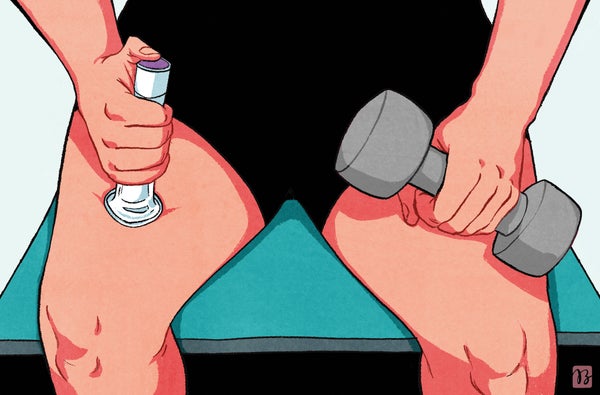
Drugs such as Wegovy and Ozempic can lead to profound weight loss, but fat isn’t the only thing that comes off. About 25 to 40 percent of the pounds shed through these treatments is lean body mass, and that includes muscle. This undesired effect has troubled older adults who are already worried about age-related muscle loss tied to falls and bone fractures. Preserving muscle matters for young adults as well: the more you have in your 30s, the more you will retain in your 60s. Losing any amount of muscle can amplify the risk of various health issues, such as declines in physical and metabolic function.
Every weight-loss intervention—including diets, bariatric surgery and glucagonlike peptide 1 (GLP-1) receptor agonist medicine such as Wegovy—melts muscle alongside fat to some degree. Now the widespread use of GLP-1 drugs is spurring scientists to work on experimental medications that could enable weight loss that barely affects muscle at all.
Muscle offers more than physical strength. These bands of fibrous tissue are important sites for storing and metabolizing glucose or for burning it for energy. A person’s muscle mass is also a strong predictor of their mobility later in life. Between our 20s and 80s we gradually lose around 30 percent of our muscle. Research suggests that GLP-1 drugs may speed up this process. Clinical trials on semaglutide (the GLP-1 sold as Wegovy and Ozempic, for example) and tirzepatide (sold as Zepbound and Mounjaro) estimate that within a few years of starting treatment, people may experience a loss of muscle mass equal to 20 years of age-related decline.
On supporting science journalism
If you're enjoying this article, consider supporting our award-winning journalism by subscribing. By purchasing a subscription you are helping to ensure the future of impactful stories about the discoveries and ideas shaping our world today.
Older people already have diminished muscle and have a high rate of GLP-1 prescriptions. The two factors could add up to a loss of strength and function.
Some researchers say the amount of muscle that many people lose during GLP-1 treatment is broadly proportional to the weight lost, which isn’t a health issue. But older people already have diminished muscle and have a high rate of GLP-1 prescriptions. The two factors could add up to a loss of strength and function. Plus, new research awaiting peer review suggests there is a link between GLP-1 drugs and increased risk of osteoporosis.
Drugmakers have a strong incentive to find solutions. Eli Lilly, the maker of weight-loss drug Zepbound and diabetes medication Mounjaro, is developing a muscle-retention drug called bimagrumab. It blocks myostatin, a key protein that helps to suppress muscle growth. Mutations in the gene that encodes myostatin make the protein less effective, and animals born with such changes can develop extraordinary amounts of muscle. Such mutations and unusual muscle growth have been documented in at least one human.
Myostatin binds to activin type II receptors on muscle cells, where it becomes an “off switch” that stops muscle development. Bimagrumab blocks these receptors, disabling the switch and allowing muscles to expand. And the effects might go beyond muscle. The drug also blocks the activin type II receptors on fat cells, and this action appears to reduce fat mass, says Steven Heymsfield, an obesity and body-composition expert at Pennington Biomedical Research Center in Louisiana. (He consults for Eli Lilly and has been involved in the company’s bimagrumab trials.)
In a phase 2 clinical trial funded by Eli Lilly and published in Nature Medicine, a team of scientists, led by Heymsfield, found that combining bimagrumab with semaglutide resulted in a 22 percent reduction in body weight over 72 weeks. But 92 percent of the weight lost was fat, compared with 76 percent of that lost on semaglutide alone. People taking bimagrumab not only maintained more muscle than those receiving semaglutide by itself, they actually grew new fibers. And people who took both drugs had the highest gains in grip strength.
Yet not all the evidence is favorable. In early trials of bimagrumab, older adults did develop more muscle but didn’t show meaningful improvements in grip strength, walking speed or endurance. This outcome could suggest that the drug “is just making the muscle bigger without the metabolic and physical function benefits,” says Dimitris Papamargaritis, an obesity researcher at the University of Leicester in England. Additional studies with tirzepatide and bimagrumab are underway.
Researchers are also pursuing another group of experimental muscle-retention drugs called SARMs, or selective androgen-receptor modulators. These synthetic compounds are designed to activate the body’s androgen receptors in a manner similar to testosterone, a hormone that can trigger muscle growth. Testosterone acts throughout the body, possibly creating bad side effects for organs such as the heart and the prostate. But SARMs are engineered to act primarily in muscle and bone, potentially promoting muscle growth with fewer side effects than testosterone. A 2025 review showed that SARMs are correlated with improvements in physical performance and body composition, but their safety profile is still unclear.
Until these new medications are shown to be safe and effective in more human trials, resistance exercise and proper protein intake are the most evidence-backed ways to protect muscle, says Ian Neeland, a cardiologist and obesity expert at Case Western Reserve University. “The vast majority of older adults can tolerate [GLP-1] medications just fine,” he says, but for those taking the drugs, Neeland recommends roughly 1.2 to 1.6 grams of protein per kilogram of body weight per day, about double the usual recommendation. He also says patients should engage in resistance training for about a third of their overall exercise time.