
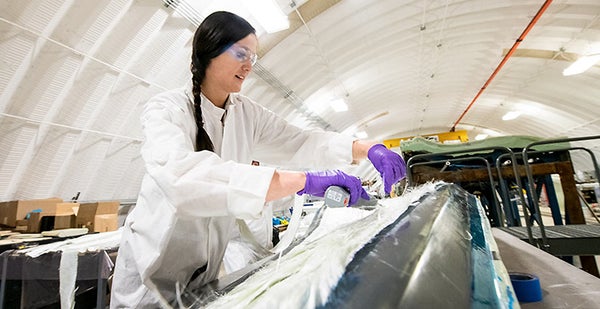
Researchers have developed a wind turbine blade that costs less and appears to be recyclable, two attributes that could accelerate the rapid growth of both onshore and offshore wind around the world.
The innovation may also reduce rising transportation costs because blades for taller turbines can now be as long as 262 feet, almost the length of a football field.
It may take years of further testing to make certain the recyclable blades can endure the outdoor elements for 30 years, which is the standard goal for the wind power industry, according to researchers at the National Renewable Energy Laboratory.
On supporting science journalism
If you're enjoying this article, consider supporting our award-winning journalism by subscribing. By purchasing a subscription you are helping to ensure the future of impactful stories about the discoveries and ideas shaping our world today.
Cutting the cost of future blades will be a “big step” in accelerating growth of wind power, said Daniel Laird, the director of NREL’s wind technology center, which has spent four years working on the new blade.
He noted that over the last three decades, research has helped drive down the costs of electricity made from wind turbines by 90%. But he added that wind power must still compete with coal, natural gas and nuclear power to keep its niche growing in the energy business.
“I think that a lot of progress is going to be made on the recyclability of blades in the next year or two,” Laird said.
Not everyone is that optimistic. The American Wind Energy Association (AWEA) recently released a paper suggesting that “repurposing” giant used blades might be a simpler alternative to recycling. The industry group says that “local communities” might use them for pedestrian bridges, playground equipment and public benches. Roofing materials is another potential use.
The AWEA report quoted Cindie Langston, manager of the solid waste division for Casper, Wyo., who was recently thrilled to receive $600,000 for dumping used wind turbine blades in the local landfill.
“This is the least problematic waste in terms of environmental concerns that we’ve ever gotten,” she explained to AWEA. “We get tires, asbestos, contaminated soil, pretty nasty stuff.”
AWEA’s report also noted that Vestas Wind Systems A/S, one of the world’s largest wind turbine manufacturers, has set a goal for eliminating conventional turbine blades by 2040.
It’s not easy to make a wind turbine blade. Conventional blades require a lot of labor. They are a sandwich composed of fiberglass, sheets of balsa wood and a chemical called an epoxy thermoset resin. A heat oven is required to give blades the proper shape, strength, smoothness and flexibility to catch the wind and turn the turbine.
The new NREL blade uses most of these components, but bonds them together with a thermoplastic resin that can harden and set the blade’s shape at room temperature. It can also be reclaimed at the end of its life by heating it into a liquid resin that can then be reused to make new blades.
That minimizes the waste problem, which became more difficult in Europe after the European Union banned old blades from being dumped in landfills. The new resin is called Elium, and it’s made by Arkema Inc., a French company with offices in King of Prussia, Pa. Arkema is working with NREL to develop the recyclable blade.
Robynne Murray, a research engineer who has been making the new blades at NREL’s laboratory, says they are stress-tested in the lab against conventional blades. Among other things, the tests show that the newer blades have what is called a greater “damping effect,” which means they reduce wind-caused vibrations, a nuisance to people that can reduce the life of turbine structures.
“This is still early days on the research,” Murray noted. “A lot of the cost modeling will come later.”
Reprinted from Climatewire with permission from E&E News. E&E provides daily coverage of essential energy and environmental news at www.eenews.net.