
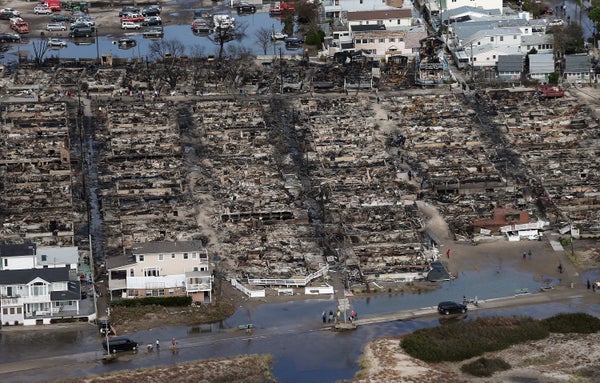
Years have passed since Hurricanes Sandy and Katrina caused severe flooding in New York City and New Orleans, respectively. But the two cities remain at risk of devastating floods—and climate change could make the situation even worse.
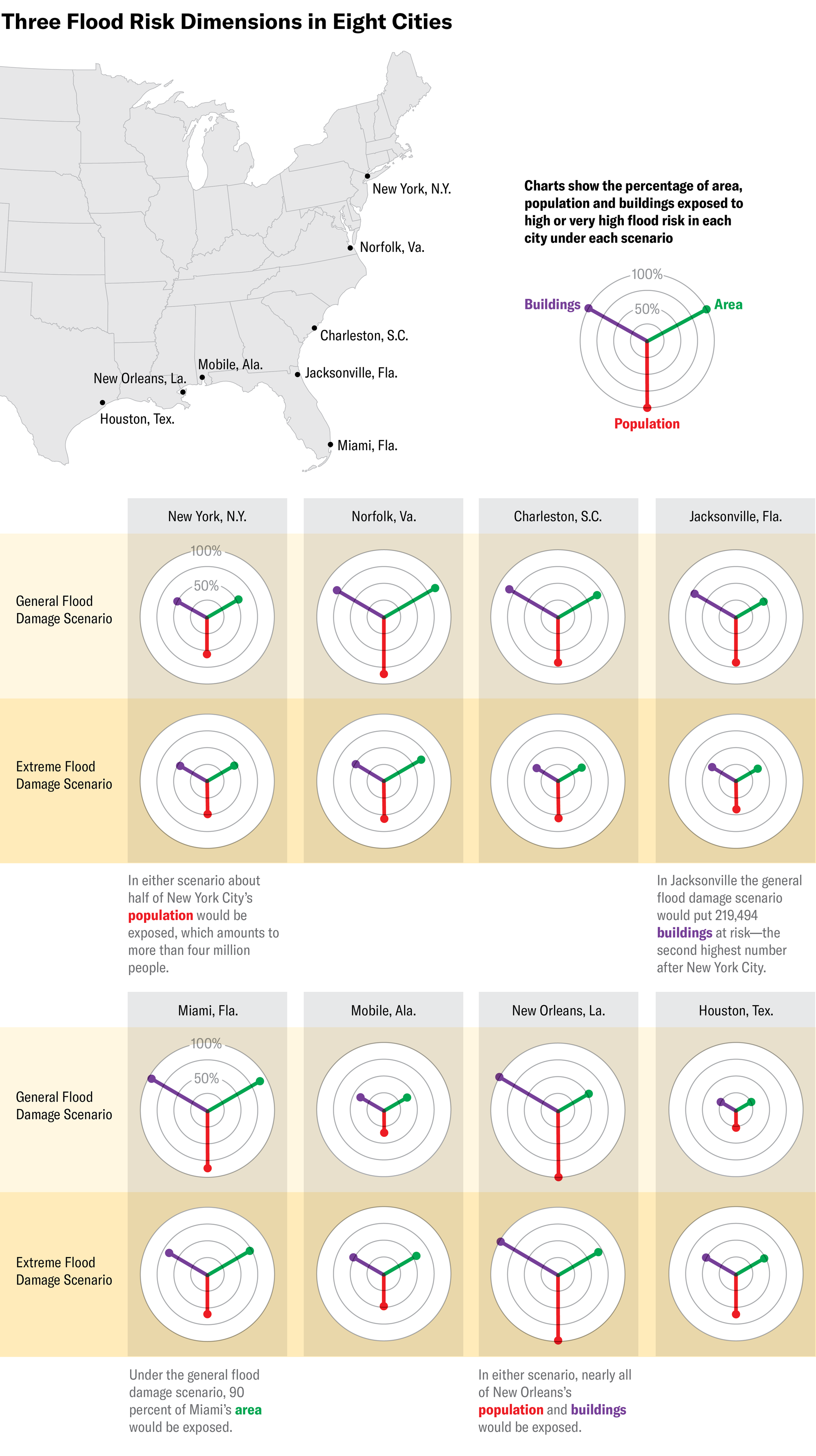
More than 4.7 million New Yorkers risk being affected by floods in some way. And according to a new study published in Science Advances on Wednesday, almost 4.4 million of those New Yorkers are at risk of “extreme” flood damage. In terms of actual numbers, the city has the largest vulnerable population in the U.S., but New York City pales in comparison to New Orleans in terms of the percentage of the total population that’s at risk: more than 98 percent of New Orleans’ residents are at risk of flooding.
What makes the situation more dire, says study co-author Wanyun Shao, is that many of the people living in the areas of those cities that are most likely to be affected by flooding belong to already at-risk populations. Shao and her colleagues used data collected from storms that occurred between 2012 and 2017 to determine where people were at most risk of floods and then analyzed those areas’ demographic information. They found that people living below the poverty line, those belonging to minority groups, people with no high school diploma and children below the age of five and the elderly were disproportionately more likely to be affected by flooding.
On supporting science journalism
If you're enjoying this article, consider supporting our award-winning journalism by subscribing. By purchasing a subscription you are helping to ensure the future of impactful stories about the discoveries and ideas shaping our world today.
“It’s not a surprise that those cities that stand out as high-risk are coastal cities along the Gulf and Atlantic Coast,” says Shao, who is an associate professor of geography at the University of Alabama. “Nevertheless, we want to put that abstract level of awareness into tangible numbers, that the coastal region is at the forefront of climate change and coastal flood hazards.”
The situation could get worse as the effects of climate change lead to more frequent and powerful storms. As the world warms, more water from the ocean is evaporating into the atmosphere, leading to more moisture that can fall as rain, leading to more intense and extreme weather. When a lot of rain falls very quickly, the ground can’t soak up the water—leading to floods. The damages can extend into the billions of dollars. And as happened in the aftermath of Hurricane Katrina and Hurricane Sandy, the floods can be deadly.
The new study highlights several other major U.S. coastal population centers as at high risk of floods. They include Norfolk, Va., Charleston, S.C., Miami, Fla., and Houston, Tex., as well as a few others.
Even though New York City and New Orleans are at such great risk, there are mitigation strategies policymakers can implement to try and reduce the chance of catastrophe, Shao says.
Constructing protective structures such as levees and dikes can help, as can preserving natural landscapes, such as wetlands and estuaries that can act as a natural sponge to absorb floodwaters, in and near the cities, Shao and her colleagues wrote. Replacing concrete in parking lots with more permeable materials, such as grass tiles, would also be beneficial.
But there are challenges to mitigation, says Jeremy Porter, a professor of sociology at the City University of New York. Waterfront property is often expensive, and it can be difficult to convince the owners to vacate.
“In a large-scale program in a city like New York, it’s really hard, with asset values, to move people out,” he says. “Oftentimes, what you’ll get from people buying the homes is them building to an adaptation level, maybe raising the house or doing something else that allows them to live in the area. But they’re adapting to the risk, as opposed to returning the land to its natural habitat so that it can naturally absorb coastal floods.”
Shao acknowledges that challenges remain but says that the study’s findings speak for themselves.
“I know that we’ve been talking about climate change, we’ve been talking about sea-level rise, we’ve been talking about hurricanes for years, if not forever,” Shao says. “But I feel like, as scientists, we shouldn’t get tired of more or less repeating ourselves and [should] always try to get the message out because it’s very important.”