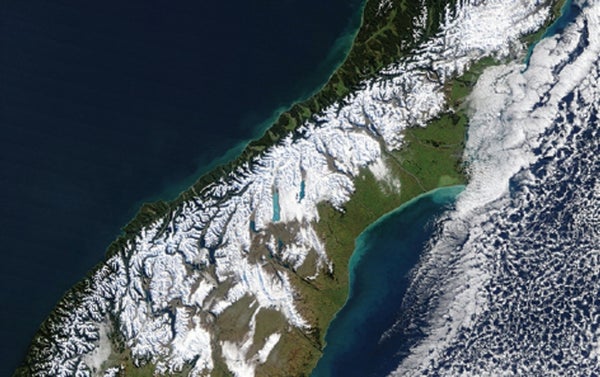
Snow line along the Southern Alps showcases New Zealand's Alpine Fault.
COURTESY OF JACQUES DESCLOITRES AND MODIS RAPID RESPONSE TEAM/NASA/GSFC
Join Our Community of Science Lovers!
To feel the earth move under your feet, visit New Zealand. Every year the sides of the island nation's Alpine Fault shift past one another about 30 millimeters—a blistering speed for strike-slip faults, which typically slip at rates closer to one or two millimeters a year. “What is particularly interesting about the Alpine Fault is that it has maintained this high slip rate for almost its entire history,” says Simon Lamb, a geologist at the Victoria University of Wellington. “As far as I can tell, no other one land fault comes close in this respect.” In fact, the Alpine Fault has shifted approximately 700 kilometers over the past 25 million years—250 kilometers more than previously estimated, according to Lamb's new study in Geochemistry, Geophysics, Geosystems. That movement has seismic consequences: New Zealand has a 30 percent chance for an earthquake of magnitude eight or higher in the next 50 years.
FAULT NAME
LOCATION
LENGTH
(km)
SLIP RATE
(mm/yr)
Alpine
South Island,
New Zealand
700
30
San Andreas
California
1,100
25
North Anatolian
Turkey
1,100
20
Denali
British Columbis
to Central Alaska
2,000
10
Altyn Tagh
Tibet
1,500
9
On supporting science journalism
If you're enjoying this article, consider supporting our award-winning journalism by subscribing. By purchasing a subscription you are helping to ensure the future of impactful stories about the discoveries and ideas shaping our world today.
Top 5 Fastest-Moving Strike-Slip Faults
Subscribe to Support Independent Journalism
Great science journalism requires human expertise, time, effort and creativity. And it costs money. That’s why I and the journalists here at Scientific American hope you’ll join our community.
When you subscribe, you are supporting staff and freelance journalists who are passionate about telling science stories that are true, important and compelling. Our editors and reporters are often experts in their fields, which means they understand the nuances of big discoveries and can untangle the breakthroughs from the hype. With a subscription, you are also supporting rigorous fact-checking to ensure the words we publish are precise and accurate. And you’re supporting original illustrations, graphics and photos that bring you closer to an advanced laboratory, an ice sheet in Antarctica or a space mission in orbit. You’re helping us craft other types of high-quality journalism as well: Our newsletters are carefully written, edited and curated by staffers you have or will come to know and love. Our Science Quickly podcast is based on original reporting, collaboration with editors and scientists and exacting production.
Subscriptions keep this engine running so we can continue to deliver thoughtful, rigorous and independent science journalism to you. In an era of viral misinformation, this work is crucial. If you value what we do, I hope you’ll consider joining us as a subscriber
Thank you,
Jeanna Bryner, Editor in Chief, Scientific American