
Here’s yet another reminder that alien worlds are far stranger and more diverse than our own solar system might suggest.
Astronomers just found a giant exoplanet three times more massive than Jupiter that loops around its host star on a highly elliptical path.
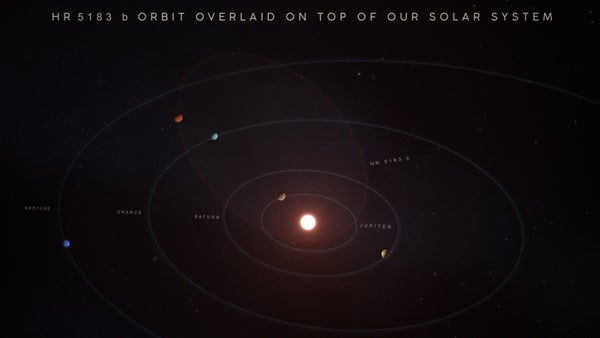
If this alien planet, known as HR 5183 b, were magically dropped into our solar system, its orbit would reach inside that of Jupiter but extend way out beyond the path of Neptune, discovery team members said.
On supporting science journalism
If you're enjoying this article, consider supporting our award-winning journalism by subscribing. By purchasing a subscription you are helping to ensure the future of impactful stories about the discoveries and ideas shaping our world today.
“This planet is unlike the planets in our solar system, but more than that, it is unlike any other exoplanets we have discovered so far,” Sarah Blunt, a graduate student at the California Institute of Technology (Caltech) in Pasadena and lead author of a new study announcing the existence of HR 5183 b, said in a statement.
“Other planets detected far away from their stars tend to have very low eccentricities, meaning that their orbits are more circular,” Blunt added. “The fact that this planet has such a high eccentricity speaks to some difference in the way that it either formed or evolved relative to the other planets.”
HR 5183 b orbits a star that lies about 100 light-years from Earth. Blunt and her colleagues found the planet using the radial velocity method, which looks for the gravitational tugs a world exerts on its host star.
The research team has been watching the parent star with several different telescopes since the 1990s. That’s not long enough to capture a full orbit of the newfound world, which takes between 45 and 100 Earth years.
But the astronomers were still able to confirm HR 5183 b’s existence, showing that the radial-velocity method can identify planets even with such partial information.
“This planet spends most of its time loitering in the outer part of its star’s planetary system in this highly eccentric orbit; then, it starts to accelerate in and does a slingshot around its star,” study team member Andrew Howard, an astronomy professor at Caltech, said in the same statement.
“We detected this slingshot motion,” Howard added. “We saw the planet come in, and now it’s on its way out. That creates such a distinctive signature that we can be sure that this is a real planet, even though we haven’t seen a complete orbit.”
The magnitude of HR 5183 b’s gravitational tug allowed the team to calculate the planet’s mass: about three times that of Jupiter.
The exoplanet almost certainly started life on a circular path but then had its orbit reshaped by a gravitational encounter, probably with a similarly sized neighbor world, study team members said.
HR 5183 b reinforces a cosmic truth: Our Milky Way galaxy is studded with a staggering array of planets. There are worlds with three parent stars and "rogues" that zoom through space alone, forever in the dark. There are huge "hot Jupiters” that circle their parents in just a few Earth days, and there are big worlds like HR 5183 b that take decades to complete a lap.
“Copernicus taught us that Earth is not the center of the solar system, and as we expanded into discovering other solar systems of exoplanets, we expected them to be carbon copies of our own solar system,” Howard said.
“But it’s just been one surprise after another in this field,” he added. “This newfound planet is another example of a system that is not the image of our solar system but has remarkable features that make our universe incredibly rich in its diversity.”
The new study will appear in The Astronomical Journal.
Copyright 2019 SPACE.com, a Purch company. All rights reserved. This material may not be published, broadcast, rewritten or redistributed.