
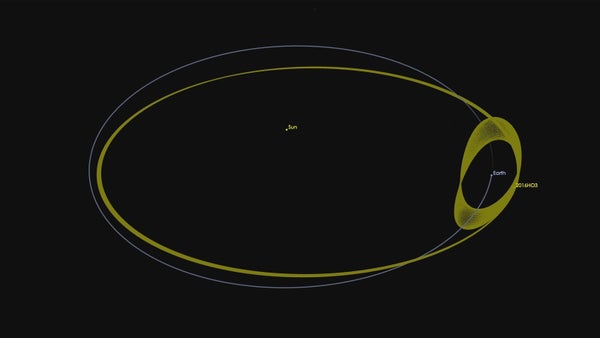
It seems the moon is not Earth's only cosmic companion.
The newly discovered asteroid 2016 HO3 orbits the sun in such a way that the space rock never strays too far from Earth, making it a "quasi-satellite" of our planet, scientists say.
"One other asteroid — 2003 YN107 — followed a similar orbital pattern for a while over 10 years ago, but it has since departed our vicinity," Paul Chodas, manager of NASA's Center for Near-Earth Object Studies at the Jet Propulsion Laboratory in Pasadena, California, said in a statement Wednesday (June 15).
On supporting science journalism
If you're enjoying this article, consider supporting our award-winning journalism by subscribing. By purchasing a subscription you are helping to ensure the future of impactful stories about the discoveries and ideas shaping our world today.
"This new asteroid is much more locked onto us," Chodas added. "Our calculations indicate 2016 HO3 has been a stable quasi-satellite of Earth for almost a century, and it will continue to follow this pattern as Earth's companion for centuries to come."
Indeed, 2016 HO3 is the best example of an Earth quasi-satellite ever found, scientists said.
The asteroid was discovered on April 27 by scientists using the Pan-STARRS 1 survey telescope in Hawaii. 2016 HO3's exact size is unknown, but researchers think it's between 130 feet and 330 feet wide (40 to 100 meters).
As the space rock circles the sun, it loops around Earth as well, zooming ahead of the planet half of the time and trailing behind the other half, NASA officials said. 2016 HO3's orbit is tilted slightly relative to that of Earth, so the asteroid also bobs up and down through our planet's orbital plane.
The path of 2016 HO3 tends to twist and drift over time, but Earth's gravitational pull keeps the asteroid contained: It never comes closer than 9 million miles (14.5 million kilometers) to our planet, and it never gets more than 24 million miles (38.6 million km) away, researchers said.
"In effect, this small asteroid is caught in a little dance with Earth," Chodas said.
This dance is not dangerous: 2016 HO3 poses no threat to the planet, NASA officials said.
Copyright 2016 SPACE.com, a Purch company. All rights reserved. This material may not be published, broadcast, rewritten or redistributed.