
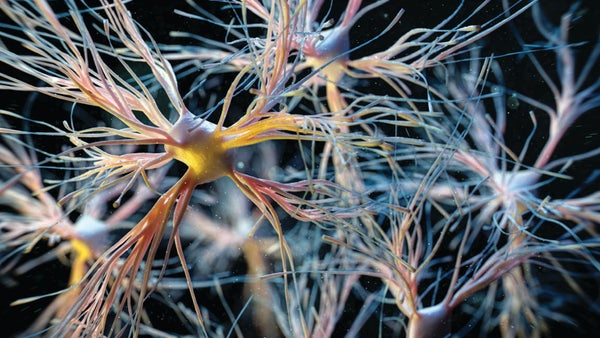
Our thoughts and feelings arise from networks of neurons, brain cells that send signals using chemicals called neurotransmitters. But neurons aren't alone. They're supported by other cells called glia (Greek for “glue”), which were once thought to hold nerve tissue together. Today glia are known to help regulate metabolism, protect neurons and clean up cellular waste—critical but unglamorous roles.
Now, however, neuroscientists have discovered a type of “hybrid” glia that sends signals using glutamate, the brain's most common neurotransmitter. These findings, published in Nature, breach the rigid divide between signaling neurons and supportive glia.
“I hope it's a boost for the field to move forward, to maybe begin studying why certain [brain] circuits have this input and others don't,” says study co-author Andrea Volterra, a neuroscientist at the University of Lausanne in Switzerland. Around 30 years ago researchers began reporting that star-shaped glia called astrocytes could communicate with neurons. The idea was controversial, and further research produced contradictory results. To resolve the debate, Volterra and his team analyzed existing data from mouse brains. These data were gathered using a technique called single-cell RNA sequencing, which lets researchers catalog individual cells' molecular profiles instead of averaging them in a bulk tissue sample. Of nine types of astrocytes they found in the hippocampus—a key memory region—one had the cellular machinery required to send glutamate signals.
On supporting science journalism
If you're enjoying this article, consider supporting our award-winning journalism by subscribing. By purchasing a subscription you are helping to ensure the future of impactful stories about the discoveries and ideas shaping our world today.
The small numbers of these cells, present only in certain regions, may explain why earlier research missed them. “It's quite convincing,” says neuroscientist Nicola Hamilton-Whitaker of King's College London, who was not involved in the study. “The reason some people may not have seen these specialized functions is they were studying different astrocytes.”
Using a technique that visualizes glutamate, the researchers observed the cells in action in live mice. They found that blocking their signaling impaired the mice's memory performance. Further mouse experiments suggested these cells might play a role in epilepsy and Parkinson's disease. Analysis of human RNA databases indicates the same cells may exist in us, but they have not been directly observed.
“People modeling brain circuits never consider these other cells,” Hamilton-Whitaker says. “Now we'll all have to agree they're part of the circuit and need to be included to understand how circuits work.”
First, neuroscientists must map where in the brain these special cells can be found. Because Volterra's team located them in structures associated with memory, the researchers plan to examine data from people with Alzheimer's disease to see whether, and how, their signaling astrocytes are altered. “We know they're located in memory circuits, so the next question is, What happens in dementia?” Volterra says. “If these cells are modified, they become a new target” for research.