
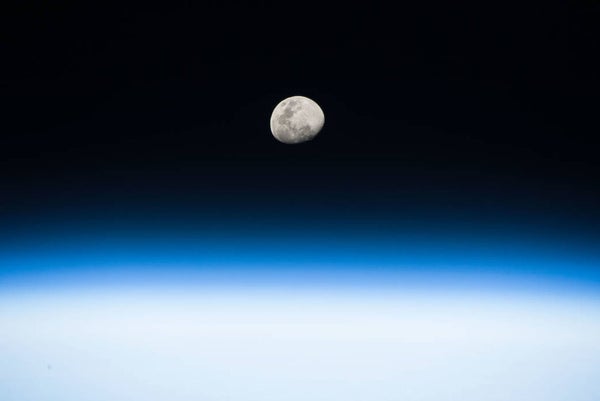
A Japanese spacecraft orbiting the moon recently made a surprising find: oxygen that came from Earth. Scientists think this oxygen could provide a historical record of our planet's ancient atmosphere.
Few reliable clues exist as to the early history of Earth's atmosphere and rocky surface because geologic activity has erased detailed evidence over time. Also wiped out are snapshot details that could be gleaned from meteorites made of material that formed around the same time and from similar material as Earth.
The discovery of terrestrial oxygen on the moon now suggests another way to get at the atmospheric history of Earth's first two billion years. The moon is constantly bombarded by a stream of highly charged particles emanating from the sun, called the solar wind. But for five days about every month our lunar neighbor is shielded by Earth's magnetosphere—a bubblelike region where the planet's magnetic field dominates. During this time, a window opens for slower oxygen ions from Earth to arrive at the moon. Scientists believe that these ions, which the SELENE spacecraft (better known as Kaguya) detected, drifted over geologic time from the outer layers of Earth's atmosphere and became embedded in the moon's regolith, a loose top layer of soil and rock. A team led by planetary scientist Kentaro Terada of Osaka University in Japan reported the result earlier this year in Nature Astronomy. “Our new finding is a direct link that ions from Earth's atmosphere are transported to the moon,” where they could remain in the lunar soils for billions of years, Terada says.
On supporting science journalism
If you're enjoying this article, consider supporting our award-winning journalism by subscribing. By purchasing a subscription you are helping to ensure the future of impactful stories about the discoveries and ideas shaping our world today.
This result excites scientists interested in a transition coinciding with the beginnings of photosynthesis in simple microbes, the planet's primeval life-forms. Somewhere around 2.45 billion years ago Earth's atmosphere changed from oxygen-poor to oxygen-rich under still mysterious circumstances that scientists call the Great Oxidation Event. Could some of the atmospheric oxygen produced at that time linger on the moon today? If scientists can collect and analyze samples of the terrestrial oxygen embedded in lunar soil, it could provide insights into how Earth's atmosphere has evolved over the eons.
In addition to trapped oxygen, the moon may harbor a trove of other evolutionary information about primordial Earth. “In principle, the moon has this remarkable collection of detritus from its sister planet,” says astrobiologist Caleb Scharf of Columbia University, who was not involved in the new research. And that detritus might carry even more intriguing data. He adds: “It's not inconceivable that there are fossil organisms in Earth meteorites on the lunar surface.”