
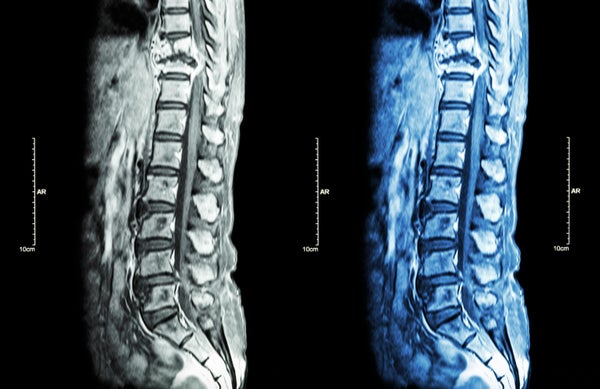
Scientists have discovered a new type of stem cell that gives rise to the backbone — and that helps to drive the frequent metastasis of breast tumours and other cancers to the spine.
Certain cancers, including those in the breast, prostate and lung, spread preferentially to the spine, but the reasons have been unknown. One theory from the1940s proposed that forceful events such as coughs can momentarily reverse blood flow and jolt cancer cells into the vicinity of the spine, where they form new tumours.
This idea “is still the classic dogma that’s taught in medical schools,” says Matthew Greenblatt, a pathologist at Weill Cornell Medicine in New York City and a co-author of the latest study. Greenblatt and his team’s results, “I would argue, overturn this very old paradigm,” he says.
On supporting science journalism
If you're enjoying this article, consider supporting our award-winning journalism by subscribing. By purchasing a subscription you are helping to ensure the future of impactful stories about the discoveries and ideas shaping our world today.
The work appears on 13 September in Nature.
Growing a spine
Spines are unique to vertebrate animals, and the spinal vertebrae don’t carry some of the proteins often thought of as characteristic of bones. These features led Greenblatt and his colleagues to suspect that they form through a different mechanism than other bones.
Working in mice, scientists in Greenblatt’s laboratory isolated stem cells from both the vertebrae and what are known as the long bones, such as the femur in the leg. They found that the stem cells from the two locations expressed markedly different sets of genes. The scientists inserted the vertebral cells into the muscles of mice and observed that the cells produced progeny reminiscent of the range of cells found in the spine. This and other evidence led them to conclude that they had uncovered vertebral skeletal stem cells, or vSSCs.
Greenblatt and his colleagues “clearly and beautifully show” that vSSCs and long bone stem cells are “very, very different,” says bone biologist Noriaki Ono at the University of Texas Health Science Center at Houston, who supplied mice for the study but was otherwise not involved in it.
Until now, many scientists have been “by and large, considering all the bones as the same organ,” says cancer biologist Xiang Zhang at Baylor College of Medicine in Houston. “This study brings our understanding to a new level.”
Bad actor
The authors’ finding made them wonder whether the new type of stem cell could account for some of the unexplained patterns in cancer metastasis. The team zeroed in on a protein called MFGE8, which is secreted by vertebral stem cells. In mouse experiments, deleting the gene for the protein cut the chance that cancer cells would spread to the animals’ spines by about two-thirds.
The researchers isolated vSSCs from people undergoing spinal surgery and found that human vSSCs secreting MFGE8 were more likely to interact with cancer cells than vSSCs that were not secreting the protein. One protein probably can’t explain the entire phenomenon, Ono says, but it seems to be an important component.
The study’s implications could reach beyond cancer. For example, spinal fusions — procedures that bridge two or more vertebrae to relieve pain from conditions such as scoliosis and arthritis — often fail for as-yet undetermined reasons, says study co-author Sravisht Iyer, a spinal surgeon at the Hospital for Special Surgery in New York City. He hopes further work on vSSCs will increase the success rate of these operations.
This article is reproduced with permission and was first published on September 13, 2023.