
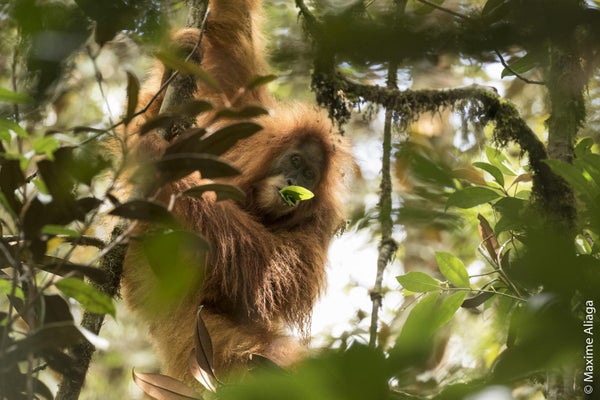
Almost a century after scientists first heard rumours of its existence, an isolated population of orangutans on the Indonesian island of Sumatra has been confirmed as a new species—just as its habitat faces imminent threats.
The population, estimated at fewer than 800 individuals, inhabits the Batang Toru forest in western Sumatra. A researcher exploring the area in the 1930s wrote of reports of an isolated orangutan population. But it wasn’t until biological anthropologist Erik Meijaard, the founder of conservation group Borneo Futures in Jakarta, discovered the paper in the mid-1990s that scientists went looking for the Batang Toru group. Local villagers showed researchers the remains of a female orangutan, and nests in the area confirmed the presence of a population. A male orangutan killed by locals in 2013 provided key evidence: intact tissue and bone.
From the start, scientists noticed that these apes looked different from other orangutans. They had smaller heads, with flatter faces, and their hair was frizzier than that of their cousins living farther north on Sumatra or on the nearby island of Borneo.
On supporting science journalism
If you're enjoying this article, consider supporting our award-winning journalism by subscribing. By purchasing a subscription you are helping to ensure the future of impactful stories about the discoveries and ideas shaping our world today.
Gene gap
Now, genetic tests, field observations and a comparison of the male skeleton against 33 orangutan specimens in museums have revealed that the Batang Toru group is, in fact, a distinct species. Named Pongo tapanuliensis, the newly identified great ape is described in Current Biology on November 2 by a team that included most of the world’s orangutan experts. “It’s taken 20 years to come to the realization of what this is,” Meijaard says.
Although the genetic analysis of P. tapanuliensis relies on a single skeleton, Meijaard says that’s not unusual in taxonomy. Many studies, including others he’s contributed to, rely on a single piece of evidence, and typically consider only morphology. The latest study shows that the group is distinct not only in morphology, but also in genetics and behaviour, he says.
Russ Mittermeier, executive vice-chair of Washington, DC-based Conservation International and chair of the primate-specialist group at the International Union for Conservation of Nature (IUCN), describes the evidence as “unquestionably” sufficient to support the new species designation. “Although we have had 87 new species of primates described since 2000, this is the first new great ape species since 1929.”
Biruté Mary Galdikas, an orangutan specialist in Los Angeles who founded Orangutan Foundation International, says that the study confirms what she and other orangutan researchers have suspected for decades. “I am not surprised that there is a new species or subspecies of orangutan described from Sumatra,” she says.
Ancestral ties
Key to the determination was tracing the population’s ancestry. Surprisingly, Meijaard says, genetic testing of the Batang Toru skeleton revealed that the population is more closely related to Bornean orangutans, despite living on the same island as the other Sumatran group. That’s probably because of how orangutans migrated to the region, he says.
All orangutans trace their origins to ancestors that lived on the Asian mainland about 8 million years ago. Those great apes migrated to what is now Sumatra, when sea levels were lower and the lands were connected. Genetic data suggest the Batang Toru species is the closest descendant of those first arrivals.
The other Sumatran orangutans, which live in the island’s far north, split off from the Batang Toru group about 3.4 million years ago, modeling based on genetic data suggests. The Bornean orangutans also split from the Batang Toru group, but much later—about 674,000 years ago—which explains why those two populations are more similar, Meijaard says.
Even as Batang Toru's orangutans are named a new species, the animals’ long-term survival is uncertain. Previous population analyses suggest there are fewer than 800 individuals, making it the most endangered of the great apes. Although much of its habitat is protected by the Indonesian government, a proposed hydroelectric dam on the Batang Toru river would flood part of the area and divide the population into two, isolating the groups on either side of the river. That’s likely to further shrink the gene pool in the already inbred population, Meijaard says. The dam would also bring more people to the area, potentially increasing hunting pressure.
Conservation groups are working with government officials to find an alternative site for the project, says Meijaard. “There is no doubt that conservation efforts are needed immediately,” Mittermeier says.
The IUCN primate-specialist group has recently recommended that the species be included on the IUCN Red List of Threatened Species. A decision is expected in December. "It would be bitterly ironic if it goes extinct as a biologically viable population just as it is described as a new species,” says Galdikas.
This article is reproduced with permission and was first published on November 2, 2017.