
Hurricane Sam, at its peak, was the most powerful storm so far this season. It topped out as a high-end Category 4 with maximum wind speeds around 155 mph, spending eight consecutive days as a major hurricane before finally beginning to weaken.
It was the strongest hurricane ever observed so far east so late in the calendar season, according to meteorologist Phil Klotzbach.
And now, scientists know what the storm looked like from the inside out. Last week, NOAA researchers sailed a drone straight into the heart of the hurricane.
On supporting science journalism
If you're enjoying this article, consider supporting our award-winning journalism by subscribing. By purchasing a subscription you are helping to ensure the future of impactful stories about the discoveries and ideas shaping our world today.
It was the first time NOAA had successfully piloted a seagoing drone inside a hurricane. The agency hopes to use scientific data, collected by special sensors on the vehicle, to improve future hurricane models and forecasts.
“We couldn’t have asked for a better storm, a Category 4 hurricane,” said NOAA scientist Greg Foltz, a co-lead on the project, in an interview with E&E News.
The feat was accomplished with a special floating vehicle designed by Saildrone Inc., which specializes in oceangoing, data-collecting drones.
Saildrones look like mini unmanned sailboats, typically equipped with 25-foot tall sails to keep them moving. In this case, the drone in question was equipped with a special “hurricane wing,” a stubbier, rigid sail designed to keep the vehicle stable in strong winds and prevent it from being crushed by large waves.
Through its partnership with Saildrone, NOAA currently has five vehicles drifting around on the open ocean. In a stroke of good luck, they noticed that Hurricane Sam was projected to pass close to one of them.
“So we positioned one of the Saildrones ahead of time, using that advance knowledge … and got it into a position where it was most likely to intercept the path of Sam,” Foltz said. “So it turned out very well.”
Tumbling about inside the hurricane, the intrepid Saildrone busily collected data on ocean temperature, ocean salinity, wind speed, air temperature and humidity, and other scientific measurements.
NOAA scientists hope the data will provide new insights into how hurricanes form and intensify.
“This is the engine of a hurricane—the source of it is the warmth of the ocean,” Foltz said. “The warmer the ocean, potentially the higher the winds can be in a hurricane. So by having these measurements, you start to get out exactly how this happens.”
Sam is a particularly useful case study. Sam underwent a process known by scientists as “rapid intensification”—that’s when a storm’s wind speeds increase by at least 35 mph in a 24-hour period. Sam exceeded this threshold several times over, ballooning from a tropical storm into a major hurricane in a matter of days.
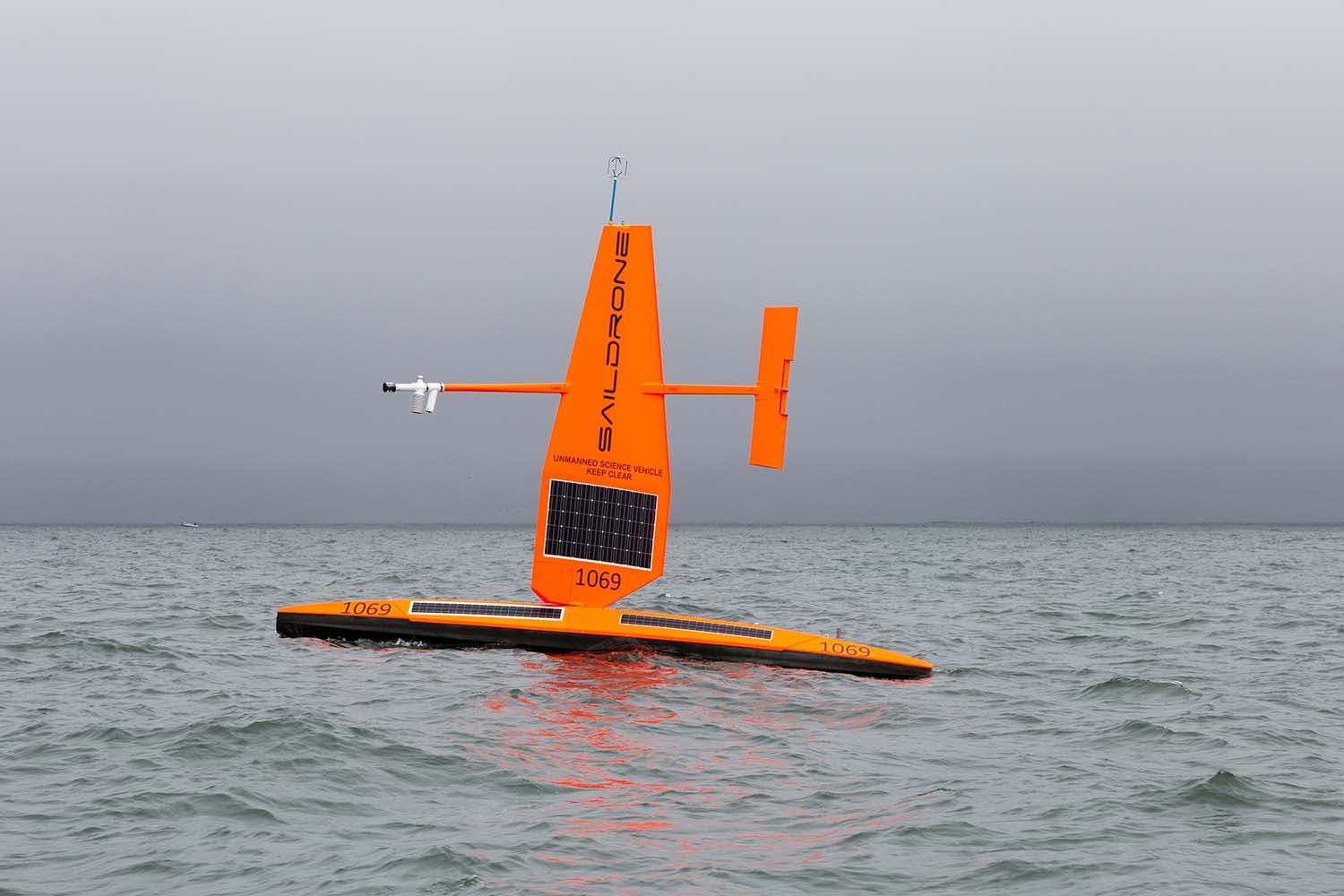
Saildrone Expolorer. Credit: Saildrone and NOAA
Rapid intensification can have major consequences in landfall-making storms. It can give coastal communities less time to prepare and organize evacuations.
It’s a process that likely will worsen with climate change. Some research suggests that rapid intensification events already have grown stronger over the last few decades, while other studies indicate that they’ll happen more frequently as the planet continues to warm.
Better understanding rapid intensification is “a big priority within NOAA,” Foltz said.
The Saildrone program is part of a larger NOAA effort to gather better scientific observations using uncrewed vehicles, or drones. Last year, the agency announced that it was establishing a new Unmanned Systems Operations Program to collect various kinds of environmental data. Hurricane research is a major priority.
In addition to Saildrone’s seagoing vehicles, NOAA has partnered with other private firms on airborne drone research. It’s used its fleet of Hurricane Hunter aircraft to drop small, flying drones into storms from above.
Both kinds of observations—from the sky and from the sea—are crucial to better hurricane forecasts, according to Foltz.
“They’re complementary,” he said. “You need the upper atmosphere measurements above the surface from these flying drones and from the earth-sea interface. And that’s what we haven’t been able to do before without something like the Saildrone.”
Reprinted from E&E News with permission from POLITICO, LLC. Copyright 2021. E&E News provides essential news for energy and environment professionals.