
The road to a Nobel Prize, the most prestigious scientific award in the world, is growing ever longer, with almost half of laureates now waiting more than 20 years from making a Nobel-worthy discovery to receiving the prize.
One analysis shows that the average time between publishing the work and receiving one of the science prizes has nearly doubled in the past 60 years. Across the three science prizes, chemistry now has the longest ‘Nobel lag’ — an average of 30 years over the past decade — and physiology or medicine has the shortest, at 26 years (see ‘Decades-long delay’).

Credit: Nature
On supporting science journalism
If you're enjoying this article, consider supporting our award-winning journalism by subscribing. By purchasing a subscription you are helping to ensure the future of impactful stories about the discoveries and ideas shaping our world today.
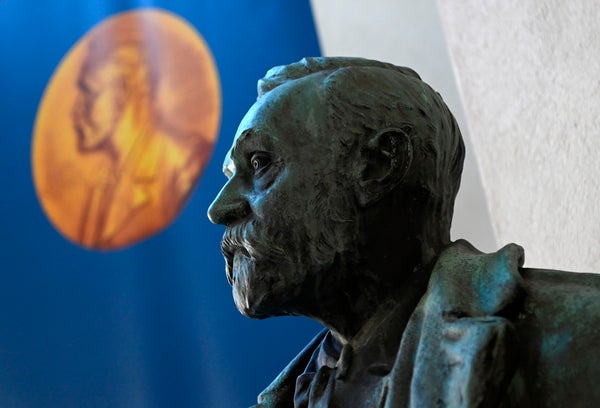
Alfred Nobel’s will stated that the prizes should be awarded “to those who, during the preceding year, shall have conferred the greatest benefit to mankind.” In reality this has only happened a few times. But in the first half of the twentieth century, it was common for Nobel prize recipients to be in their 30s — and that is unheard of now, says Santo Fortunato, now a computational social scientist at Indiana University in Bloomington, who published a 2014 analysis on Nobel prizewinners since the award’s conception in 1901. His results showed that the time between laureates’ prize-winning research and their Nobel had slowly increased over the years, with a steeper slope after the 1960s than in the early years of the prize.
There are a number of possible reasons for this trend, says Yian Yin, a computational social scientist at Cornell University in Ithaca, New York. It could be that the overall number of breakthroughs is increasing each year, so awards cannot keep up with the number of people who deserve to be recognized, he says. It is also the case that the importance of some works, which Yin describes as ‘sleeping beauties,’ are only realized years or decades later.
Alternatively, the lengthening gap could be a sign that there has been a decrease in ‘disruptive’ science — important studies or discoveries that change the paradigm of their field. This could be causing the Nobel committees to focus more on the past.
The number of ‘big-splash’ discoveries are diminishing, but when they do happen, they tend to get recognized quickly, says Fortunato. For example, biochemists Jennifer Doudna at the University of California, Berkeley and Emmanuelle Charpentier at the Max Planck Unit for the Science of Pathogens in Berlin, won the 2020 Nobel Prize in Chemistry just eight years after their development of the CRISPR–Cas9 system as a genome-editing tool. Some researchers speculate that the inventors of mRNA vaccines, which were rolled out to millions of people worldwide during the COVID-19 pandemic, could receive similar recognition.
Fortunato points out that, if the gap continues to grow, prominent scientists could miss out on the award owing to the Nobel Committee’s rule banning posthumous prizes (with the exception of the 2011 Nobel Prize in Physiology or Medicine, a share of which was awarded to physician Ralph Steinman, who had passed away three days before the announcement, unbeknownst to the committee). “It has to stop at some point,” he says, adding that a rethink of the posthumous-awarding ban would allow more people’s work to get the recognition that it deserves.
This article is reproduced with permission and was first published on September 29, 2023.