
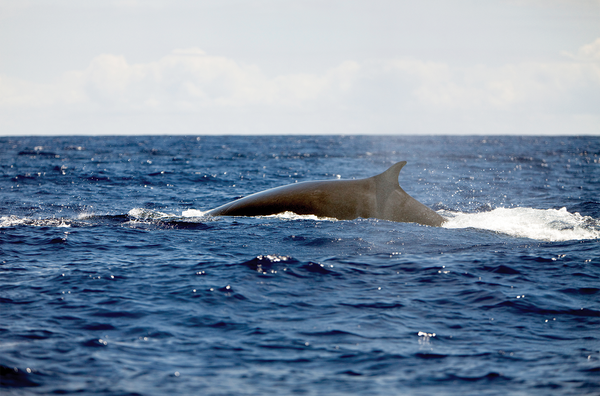
An unlikely source is revealing some secretive habits of whales: the group tasked with monitoring nuclear weapons testing. The underwater hydrophone network of the Preparatory Commission for the Comprehensive Nuclear-Test-Ban Treaty Organization (CTBTO) was designed to listen for massive explosions, but its sonic sensors more often pick up the peaceful rumblings of the world's largest animals. Now scientists are exploiting this unique data set to estimate fin whale population sizes and movements, which could improve the species' uncertain conservation prospects.
In the past 20 years the CTBTO has installed 11 acoustic stations throughout the world, including six in the oceans. Each contains two sets of three hydrophones that receive signals and determine their origin. CTBTO observations helped to detect North Korea's 2017 nuclear tests and have yielded a treasure trove of scientific data.
These recordings are producing revelations about endangered fin whales, a species rebounding from hunting during the 20th century. Tarun Chandrayadula, an ocean engineer at the Indian Institute of Technology Madras, and his colleagues recently detected fin whales in CTBTO recordings off the southern tip of India—a region the species was not known to frequent. The finding, which Chandrayadula is working to publish, is helping boost his efforts to build a “whale atlas” detailing the annual movements of Indian Ocean cetaceans.
On supporting science journalism
If you're enjoying this article, consider supporting our award-winning journalism by subscribing. By purchasing a subscription you are helping to ensure the future of impactful stories about the discoveries and ideas shaping our world today.
CTBTO data can also help determine whales' population sizes—a prerequisite for effective conservation efforts. Danielle Harris, a marine biologist at the University of St. Andrews in Scotland, led a study published in May presenting a new method for estimating whale numbers using CTBTO's sparse hydrophone array. Harris calculates there is approximately one fin whale per 2,000 square kilometers near Wake Island, a coral atoll in the central Pacific Ocean.
“The first step is knowing how many animals you're trying to conserve,” says Sean Wiggins, a project scientist at the Scripps Institution of Oceanography, who was not involved in either Harris's or Chandrayadula's studies. But the CTBTO data have their limitations, Wiggins adds. The hydrophones detect sounds below 100 hertz, so they cannot sense the vocalizations of small whales or dolphins. Furthermore, the vast spaces between hydrophone stations make it difficult to pinpoint a whale's distance from a sensor—a problem Harris's new method attempts to resolve.
Still, CTBTO's 15-year record of global whale chatter is a boon for marine biologists, and the recordings can spark joy. “I thought it was the most fun thing,” Chandrayadula says, “just sitting at my desk and listening to these otherworldly creatures.”