
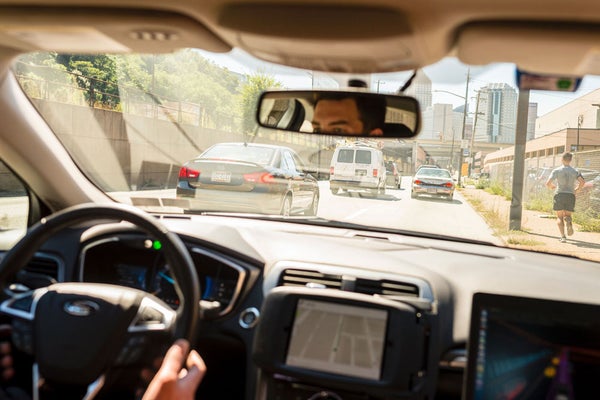
Self-driving cars were a lot simpler when they were still confined to science fiction. But Uber’s recent rollout of semiautonomous taxis in Pittsburgh and the tough questions Tesla faces after a death involving its Autopilot feature are strong reminders that fact is quickly closing in on fiction. In an effort to keep the two from colliding, the U.S. Department of Transportation (DoT) on Tuesday made good on its promise earlier this year to give Silicon Valley start-ups and Detroit incumbents alike guidance to help them build safe self-driving vehicles.
The DoT’s new Federal Automated Vehicles Policy includes a 15-point safety assessment to help autonomous vehicle makers evaluate their technology in areas including data recording and sharing, vehicle cybersecurity, and how the vehicles interact with human drivers and passengers. The guidelines state that reporting these safety assessments to the National Highway Traffic Safety Administration (NHTSA) is voluntary, but could become mandatory as the DoT develops formal autonomous vehicle regulations.
The safety assessment is significant because it gives tech companies and automakers some much-needed guidance as they hurtle into a murky future. “The public is asking themselves if, once these regulations are followed, are autonomous vehicles going to be safe?” says Nidhi Kalra, a senior information scientist at research institute RAND Corp. and co-director of its Center for Decision Making under Uncertainty. Right now the answer is “maybe,” Kalra says. Whether autonomous vehicle makers will ever be able to answer “yes” to that question is complicated—there is no test to determine whether an autonomous vehicle is safe nor is there even a consensus as to how safety is defined. “Some people will not accept mistakes from machines, even if those mistakes occur at a lower rate than they do with humans,” Kalra says. “Others will say that if the vehicles are safer than the average human driver, then we should allow them on the roads.”
On supporting science journalism
If you're enjoying this article, consider supporting our award-winning journalism by subscribing. By purchasing a subscription you are helping to ensure the future of impactful stories about the discoveries and ideas shaping our world today.
The DoT’s guidelines clarify the roles that federal and state governments will have in regulating self-driving cars. The federal government will continue to be responsible for the safety of the vehicles themselves—including the software that allows them to operate autonomously—while the states remain in charge of regulating human drivers when they are at the wheel, according to Secretary of Transportation Anthony Foxx. At a press conference announcing the policy, Foxx also noted that the DoT will put in place an exemption process that companies can take advantage of if they want to depart radically from current vehicle designs—such as eliminating steering wheels and brake pedals—if they can prove that the new design improves vehicle safety.
In March the DoT acknowledged that current federal motor vehicle safety standards did not directly address automated vehicle technologies. The newly proposed regulations are an effort to remedy this problem, as carmakers and tech companies hurry to develop and sell new self-driving technologies. The main focus is on highly automated vehicles that can take full control of the driving task in at least some circumstances. Portions of the guidelines also apply to lower levels of automation, including some of the driver-assistance systems already being deployed by automakers today.
The DoT is walking a fine line as it tries to clear a path for autonomous vehicles while ensuring those vehicles meet the safety goals at the core of the agency’s mission, says Ragunathan Rajkumar, a professor of electrical and computer engineering in Carnegie Mellon University’s CyLab Security and Privacy Institute and a veteran of the university’s efforts to develop autonomous vehicles—including the Boss SUV that won the Defense Advanced Research Projects Agency (DARPA) 2007 Urban Challenge. As a result, the policy “will be seen as a milestone and also debated widely,” Rajkumar says. The DoT built some flexibility into its guidance by stating that the policy will be updated annually as technologies and circumstances develop.
The DoT has long positioned self-driving cars as the key to improving automobile safety, reducing the country’s dependence on oil and addressing the gridlock that increasingly chokes major cities. The new policy “provides the path toward a fully driverless car,” NHTSA Administrator Mark Rosekind said at Tuesday’s press conference. His agency released preliminary data on July 1 showing an estimated 35,200 people died in motor vehicle traffic accidents last year, up 7.7 percent from 2014.
The DoT hopes its current approach—encouraging both autonomous vehicle development and safety—will bring those numbers down significantly. “They see an enormous opportunity for improving driving by reducing mistakes that humans make,” RAND's Kalra says.