
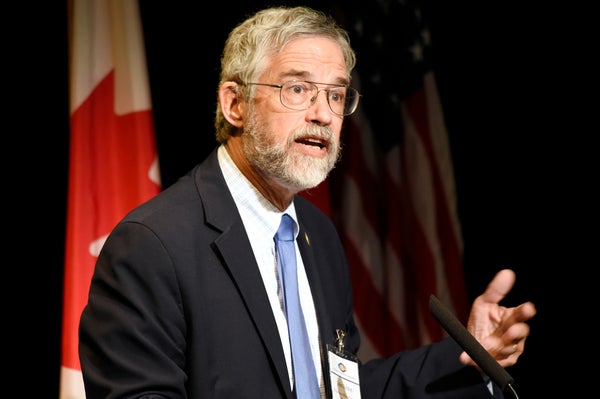
Former White House science adviser John Holdren has condemned US President Donald Trump’s decision to temporarily ban all refugees and citizens of seven majority-Muslim countries from entering the United States.
Holdren, who served eight years under President Barack Obama, told Nature on January 30 that the ban is “perverse” and “an abomination, and a terrible, terrible idea”. The executive order enacted on 27 January will not increase the country’s security, he adds, and may damage it by sending an offensive message to Muslims, who make up a quarter of the world population.
“If the ban is maintained, it will damage a wide array of collaborations in science and technology around the world,” says Holdren, who led the White House Office of Science and Technology Policy from 2009 until earlier this month. “A more prosperous world is a more stable world, and it’s clear that innovations in science and technology drive economic growth.”
On supporting science journalism
If you're enjoying this article, consider supporting our award-winning journalism by subscribing. By purchasing a subscription you are helping to ensure the future of impactful stories about the discoveries and ideas shaping our world today.
The ban has inspired shock, fear and confusion among researchers in the US and around the world. It prevents refugees from entering the United States for 120 days, and bars those from Syria indefinitely. Citizens from Iran, Iraq, Libya, Somalia, Sudan, Syria and Yemen are banned for 90 days.
The US government has offered conflicting interpretations about how the policy applies to people from the seven countries who hold visas that allow them to live, work or study in the United States. The White House now says that people with the permanent-resident visas called green cards will be evaluated on a case-by-case basis if they seek to enter the US.
However, multiple researchers told Nature that airlines have erred on the side of caution, and decided not to allow anyone with passports from these countries to board connecting flights to the US due to uncertainty about the changing rules.
Trump defended the ban in a statement issued on January 29. “This is not about religion—this is about terror and keeping our country safe,” he said.
But Holdren says that Trump's immigration stance could begin to undermine the international science ties that Obama sought to build during his eight years in office—and in doing so, make the world less safe. Such relationships also aid the United States, he argues, by helping other nations to improve their ability to respond to global emergencies such as pandemics.
“Our scientific collaborations with China mean we get notice on influenza outbreaks immediately so that we can develop vaccines to target the right strain of the virus months ahead of time,” Holdren says.
Holdren is also shaken by reports that government science agencies have instructed their employees not to talk to Congress or to the press. In at least some cases, those orders have reportedly come from high-ranking career civil servants at science agencies, rather than the White House itself.
“During a transition there is a tendency to want to get the new teams up to speed before they communicate to the press, but what has happened so far is beyond what is normal for transitions,” Holdren says. "I suspect that the combination of swiftness and comprehensiveness of the Trump team’s restrictions may well be unprecedented."
This article is reproduced with permission and was first published on January 30, 2017.