
Ocean acidification threatens to cause billions of dollars in damage to the U.S. economy, harming everything from crabs in Alaska to coral reefs in Florida and the Caribbean, NOAA researchers said in a new report.
Carbon dioxide emissions and ocean acidification are occurring at an "unprecedented" rate, deteriorating valuable fisheries and tourist destinations across the United States and its territories, NOAA said in a draft research plan for ocean acidification.
"Commercial, subsistence and recreational fishing [and] tourism and coral ecosystems" will likely be damaged by ocean acidification, the plan said. Multibillion-dollar fisheries such as West Coast Dungeness crab, Alaska king crab and New England sea scallops are vulnerable. So are Florida's coral reefs, an asset valued at $8.5 billion.
On supporting science journalism
If you're enjoying this article, consider supporting our award-winning journalism by subscribing. By purchasing a subscription you are helping to ensure the future of impactful stories about the discoveries and ideas shaping our world today.
Implicating human activities such as burning fossil fuels, the plan said that ocean acidification "is driven by the growing amount of anthropogenic carbon dioxide absorbed and dissolved in the upper ocean." Ocean acidification makes it hard for some marine organisms such as lobsters, oysters and coral to build shells and skeletons.
The 172-page draft research plan draws on hundreds of studies and describes how NOAA will continue to analyze ocean acidification in the 2020s as part of a congressional mandate. The NOAA plan is unique in that it assesses the threat of ocean acidification nationwide, in contrast to other research that might focus on a specific part of the country.
Two U.S. regions appear particularly endangered: Alaska, with its lucrative seafood industry, and the Florida Keys, Puerto Rico and the U.S. Virgin Islands, whose coral reefs attract tourists and protect against flood damage and coastal erosion.
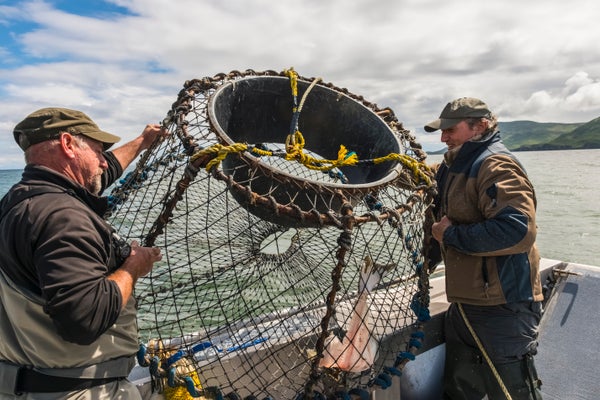
"Alaska waters are especially vulnerable to OA," the research plan said, using the acronym for ocean acidification. Most vulnerable are Alaska communities that rely on subsistence crab harvests and communities with fishing economies.
Alaska's seafood industry employs more than 50,000 people, pays $2 billion a year in wages, and includes the nation's largest and most valuable crab fishery. It also is an essential part of the state's culture and identity, which ocean acidification jeopardizes.
"The harvest of marine resources plays a critical role in the identities and well-being of Alaska communities," NOAA's research plan said. "More so than any other Americans, Alaskans rely upon subsistence harvests of marine resources to meet their daily nutritional needs."
In the Florida Keys, Puerto Rico and the Virgin Islands, ocean acidification is creating "a great urgency" because the region features sensitive coral reef ecosystems and commercially important fisheries, NOAA said.
Coral reefs in southeast Florida generate $4.4 billion in annual sales, $2 billion in income, and 70,400 full- and part-time jobs — "much of which will be threatened due to OA's effects on reef-building corals," NOAA said.
Though valued largely for their beauty, coral reefs also "can substantially reduce" coastal flooding and erosion by dissipating the energy of waves hitting the shore, NOAA said. An April report by the U.S. Geological Survey found that coastal reefs protect economic activity worth $319 million a year in Florida, $118 million a year in Puerto Rico and $25 million a year in the Virgin Islands.
NOAA has not officially released its 2020-2029 research plan for ocean acidification. A draft became public in December when it was posted by NOAA's Science Advisory Board, whose reviewers called it a "brilliant research plan."
"This research plan captures NOAA's extraordinary effort to improve the ability to understand, protect, manage, and restore ecosystems that support healthy fisheries, increase opportunities for aquaculture, and balance conservation with tourism and recreation," wrote reviewers Joellen Russell of the University of Arizona, Irina Marinov of the University of Pennsylvania and Nancy Williams of the University of South Florida.
A 2009 federal law requires NOAA to monitor and research the potential effects of ocean acidification and to suggest adaptation and conservation steps.
Congress has strongly supported NOAA's ocean acidification program. The fiscal 2020 budget approved in December provides $14 million — more than double the $6 million the program got in fiscal 2014.
NOAA's proposed research plan highlights the potential harm of ocean acidification along the Pacific coast and parts of the Atlantic coast. In New England and Mid-Atlantic states as far south as North Carolina, the vulnerability to ocean acidification is "high to medium-high."
On the West Coast, the largest economic harm likely will occur from Northern California to northern Washington due to "declines in Dungeness crab and groundfish."
But the plan finds uncertainty in other places.
The impacts of ocean acidification on fisheries and aquaculture in the southeast Atlantic and Gulf of Mexico "are poorly understood" because research on the issue is "scarce," NOAA said.
In the Great Lakes, which are experiencing acidification even though they are fresh water, the potential impacts "are largely unknown at this time," NOAA said.
Reprinted from Climatewire with permission from E&E News. E&E provides daily coverage of essential energy and environmental news at www.eenews.net.