
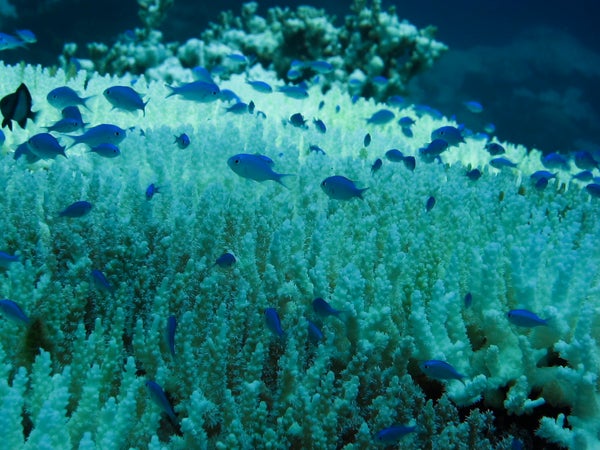
It’s not just global air temperatures that are heating up. Ocean heat waves are happening more frequently and lasting longer, too—a potential major threat to coral reefs and other marine organisms, according to new research.
A study published yesterday in Nature Communications suggests that there’s been a 54 percent increase in the number of annual “marine heatwave days” since the 1920s—that is, the total number of days each year that a marine heat wave is occurring somewhere around the world. Overall, heat waves are lasting about 17 percent longer than before, and their frequency has increased by about a third.
The researchers say that rising ocean temperatures, driven by human-caused climate change, are mostly to blame. While natural climate variations like El Niño do affect the frequency and severity of heat waves from one year to the next, the study suggests the increases are mainly linked to long-term changes in sea surface temperatures.
On supporting science journalism
If you're enjoying this article, consider supporting our award-winning journalism by subscribing. By purchasing a subscription you are helping to ensure the future of impactful stories about the discoveries and ideas shaping our world today.
That means marine heat waves may become an even bigger problem in the coming decades. Because ocean warming is expected to continue throughout the rest of the century, “we expect a continued global increase in marine heatwave frequency and duration in the future with implications for marine biodiversity and the goods and services ocean ecosystems provide,” the researchers note in the study.
Marine heat waves are similar to terrestrial heat waves—they just occur in the water instead of in the air. Scientists define them as periods when the sea surface in a given area of the ocean gets unusually warm for at least five days in a row.
The scientists, led by Eric Oliver of Dalhousie University in Canada, investigated long-term heat wave trends using a combination of satellite data collected since the 1980s and direct ocean temperature measurements collected throughout the 21st century to construct a nearly 100-year record of marine heat wave frequency and duration around the world.
They found that heat waves are not only increasing overall but that the increases are accelerating. The study suggests that the greatest changes in heat wave trends have occurred in the last few decades.
Meanwhile, research suggests that ocean warming as a whole has also been speeding up. Last year, a study published in Science Advances found that the oceans have been steadily storing more heat since the 1980s and that deeper layers of the ocean are starting to warm up, as well.
While the new study looks at long-term trends, some scientists have also begun to evaluate the influence of climate change on individual heat wave events—and they’re making some worrying discoveries, as well.
In December, a special edition of the Bulletin of the American Meteorological Society included a selection of studies investigating the influence of climate change on a variety of recent extreme weather and climate events, including marine heat waves. One paper found that a 2016 marine heat wave off the coast of Alaska was unprecedented in terms of the temperatures it reached and concluded that it would not have been possible in a world where human-caused climate change was not occurring.
An increase in these types of events is a big concern for marine scientists. Rising ocean temperatures can affect ocean ecosystems in a variety of negative ways.
Coral reefs may be some of the worst affected. A recent study, published January in Science, found that severe coral bleaching events—which are generally triggered by high ocean temperatures—have already increased in frequency nearly fivefold since the early 1980s (Climatewire, Jan. 5). One of these events, a global bleaching event that began in 2014 and affected at least 70 percent of the world’s reefs, just ended last year.
But the researchers point out that other ecosystems may be in jeopardy, as well.
Regional studies suggest that marine heat waves may provoke “widespread loss of habitat-forming species such as kelps and corals, drive shifts in species distributions, alter the structure of communities and ecosystems, and have economic impacts on aquaculture and seafood industries through declines in important fishery species,” they note. “Such ecological impacts are likely to have become more prevalent with the increasing frequency and duration of [marine heat waves] over the last century.”
Reprinted from Climatewire with permission from E&E News. E&E provides daily coverage of essential energy and environmental news at www.eenews.net.