
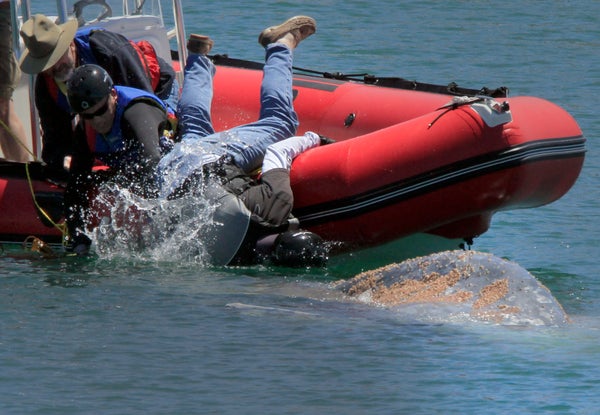
Ocean warming has led to more whales being entangled in fishing gear off the California coast, according to research published yesterday in Nature Communications.
The study found connections among changes in forage species from heat waves, a recovery of whale populations and an increased number of whales being entangled in fishing nets.
And the paper proposes an index for assessing the risks to marine life and fisheries' economic stability.
On supporting science journalism
If you're enjoying this article, consider supporting our award-winning journalism by subscribing. By purchasing a subscription you are helping to ensure the future of impactful stories about the discoveries and ideas shaping our world today.
"Warming of the ocean is impacting the ecosystem shift, and so we've had to come up with a new index to better monitor it," said Jarrod Santora, the study's lead author, an ecosystem oceanographer with NOAA Fisheries and an associate researcher at the University of California, Santa Cruz.
Major marine heat waves from 2014 to 2016 reduced offshore krill populations, which left migrating humpback whales hungry and searching for anchovies along the coast near active fisheries.
Additionally, the massive 2019 heat wave, also known as "the blob," delayed the crab season, which exacerbated the issue of whale entanglements.
"That switch from feeding in the oceanic environment in the outer shelf break to the near-shore environment coincided with this amplified co-occurrence between whales and fishing gear," Santora said.
Santora blamed a lack of communication between scientists and fisheries managers for the spike in whale entanglements but said stakeholders now have the tools to mitigate risks.
There are efforts underway to fix that. The California Dungeness Crab Fishing Gear Working Group, for example, was organized by the California Department of Fish and Wildlife, in partnership with the California Ocean Protection Council and NOAA Fisheries, to focus on reducing whale ensnarement. Santora is a scientific adviser for the group.
"The working group's goal is really to ensure thriving whale and sea turtle populations as well as a thriving and profitable commercial Dungeness crab fishery off the coast," said Paige Berube, the sustainable fisheries program manager for the council.
Berube said this study highlighted climate impacts to socioeconomic aspects and ecological conservation.
"I think this paper is an example of how issues of marine heat waves are interconnected with the overall marine ecosystem and are something that needs to be considered in fisheries management going forward," Berube said.
Marissa Baskett, an associate professor of environmental science and policy at UC Davis, studied the impacts of marine heat waves on coral reefs and kelp.
Baskett explained that the bleaching of coral reefs was the first signal of changes from warming oceans. The effects of warming on coral and kelp have provided an example for outcomes in other species like the humpback whales.
"I think it's a question of each system learning from the previous and hopefully being able to respond more rapidly based on the lessons learned," Baskett said.
Despite the spike in entanglements, the resurgence of whale populations surprised Santora and motivated him to think differently for future studies.
"It caused me to really rethink a lot of the science I'm doing going forward to account for climate variability, increased predator population and dealing with these challenging socioeconomic aspects," Santora said.
Santora noted the need for future studies on the socioeconomic impacts to learn from past negative impacts to fisheries.
Reprinted from Climatewire with permission from E&E News. E&E provides daily coverage of essential energy and environmental news at www.eenews.net.