
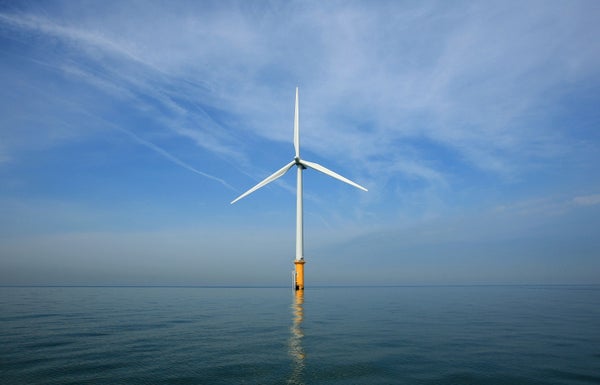
NEW ORLEANS—The first offshore wind farm in the United States is set to begin delivering power to Rhode Island’s electricity grid by year’s end, a milestone that could help reshape energy markets from New England to South Florida, experts say.
But for U.S. offshore wind power to achieve its full potential, as much as 4 gigawatts of capacity, it will need a major influx of capital and know-how, much of which will come from Europe, where the technology has a 25-year performance record and now accounts for 11 GW of generation capacity on the continent.
Representatives of top U.S. and European wind firms—including executives of Deepwater Wind, the firm building the 30-megawatt Block Island Wind Farm off Rhode Island—told industry peers gathered on the Gulf Coast last week that the industry should act now to establish the technical, logistical and policy frameworks to build more offshore wind farms in the United States.
On supporting science journalism
If you're enjoying this article, consider supporting our award-winning journalism by subscribing. By purchasing a subscription you are helping to ensure the future of impactful stories about the discoveries and ideas shaping our world today.
Such priorities include setting up domestic supply chains to serve offshore regions and training a skilled workforce to deploy into the offshore wind environment, particularly along the Atlantic coast. That’s where developers are snapping up federal leases on the outer continental shelf that could support hundreds of turbines by 2025, officials said.
James Bennett, chief of the Office of Renewable Energy Programs for the Bureau of Ocean Energy Management, an Interior Department subagency, said the government has leased 11 tracts off the Northeast and Mid-Atlantic coast where wind speeds are considered superb. More lease sales are in the works for tracts as far south as Florida.
Finding and securing the offshore wind sites is only half the battle. Attracting finance and development partners is an equally critical challenge for U.S. firms, even those that have been successful in building and operating major onshore projects in the United States.
That’s because the offshore environment poses unique challenges in almost every phase of development, from design and engineering to permitting, construction, operations and maintenance.
And while considerable attention has been given to the transfer of knowledge and skilled workers from the offshore oil and gas industry to offshore wind power, experts cautioned that there are key differences between the two sectors, both in terms of how they function and the scale of operation.
For example, an oil and gas field is often served by one or two large offshore rigs whose octopus-like collection systems spread across the seafloor, gathering fuels and pumping them to a centralized point. Offshore wind farms, by contrast, are composed of dozens, or even hundreds, of finely tuned mini-power plants resting atop towers distributed across several square miles of the ocean’s surface.
GE looks to the ocean
Arnold Wilmink, vice president of wind engineering for E.ON North America, a subsidiary of the German conglomerate whose global renewables capacity exceeds 5.2 GW, said there are commonalities between the two sectors. But there is no seamless transfer of oil-and-gas-industry skills to the offshore wind environment. Worker training for a nascent U.S. offshore wind industry is imperative, he said.
In terms of materials and equipment, experts said much of the supply chain will have to be sourced initially from Europe, where developers like Vestas Wind Systems A/S and Siemens AG are already producing the larger nacelles, gearboxes and turbine blades required for offshore wind power. The United States’ largest renewable energy firm, General Electric Co., is moving into the marketplace, aided by its recent acquisition of the power systems division of Alstom SA, a French conglomerate.
By virtue of that acquisition, GE is now a partner and supplier of Deepwater Wind’s five 6-MW Haliade 150 offshore turbines being installed off Block Island. It has established a temporary manufacturing facility at the Port of Providence for the assembly of turbine components.
Where U.S. developers face the greatest risk of failure is in the regulatory arena, where offshore energy activities are subject to a unique set of requirements and regulations. “In the U.S., when it comes to permitting, [offshore is] a different ballgame,” Wilmink said. “We’ve got to figure out if the same permitting rules onshore apply to offshore, as well.”
Offshore developers, both in Europe and the United States, also must be mindful about driving down costs so offshore wind energy can compete economically against both onshore wind and other competing fuels, including natural gas. Onshore wind energy costs have seen a more than 60 percent drop over the last few years, while offshore wind has remained more expensive due to its more complicated siting, engineering and logistical challenges.
Even so, officials said they believe the cost-benefit equation is shifting in favor of offshore wind, especially as more countries, regions and states seek to replace large carbon-emitting power plants with cleaner baseload energy.
“We need to transform offshore wind from something where society says, ‘Offshore wind is nice, but we cannot afford it,’ into something like, ‘Offshore wind is nice, and we cannot afford not to [do it],’ and we are just about doing that,” said Michael Hannibal, chief executive officer of offshore wind for Siemens Wind Power.
Offshore wind a ‘geographic play’
The U.S. market has also been affected by negative public perceptions of offshore wind, most notably in New England, where the long-awaited Cape Wind project in Nantucket Sound became mired in controversy and lawsuits dating to the early 2000s. After years of fits and starts, that project remains on hold, even as Massachusetts lawmakers prepare to require the state to contract for 1.2 GW of offshore wind energy by 2027.
But other developers are lining up to fill the gap, including the Danish firm DONG Energy, which last year secured a federal lease roughly 15 miles south of Martha’s Vineyard, Mass., to build up to 1 GW of offshore wind capacity that would be sold into the Massachusetts market.
Danielle Lane, business support director for DONG, said the Massachusetts site, known the Bay State Wind project, represents a unique opportunity for the utility to enter the U.S. market with a high level of certainty that the economics will pan out. “It’s fair to say the Northeast of the U.S. has some of the best wind conditions that we’ve found across the globe,” she said, “and that’s why we made the decision to make this our first market to build outside of Europe.”
DONG’s U.S. vision extends beyond Massachusetts, too. It recently acquired a second federal lease site off the New Jersey coast that was initially acquired last November by RES Americas Inc. for undisclosed terms. If the 160,000-acre lease area is approved for development, it could support an additional 1 GW of generation capacity that could be delivered into East Coast power markets.
Jeff Grybowski, chief executive officer of Deepwater Wind, said that offshore wind in the United States is currently a “geographic play,” meaning its higher installation and operations costs are offset by production sites’ close proximity to major demand centers along the Eastern Seaboard.
As it stands, Rhode Islanders will pay considerably more for their new offshore wind energy, with an initial contracted price of 24.4 cents per kilowatt-hour for generation delivered from the Block Island turbines to National Grid USA, the regional utility, via an underground cable.
That’s about 10 cents more than Rhode Islanders currently pay for residential power, according to the U.S. Energy Information Administration.
Deepwater Wind officials and wind power proponents have defended the pricing, noting that Block Islanders currently pay between 38 and 58 cents per kWh for electricity produced from diesel generators run on imported fuel. By eliminating the diesel generators, Rhode Island will both clean up its power supply and deliver cheaper power to more than 1,000 ratepayers on the island.
Grybowski added that offshore wind’s prospects are also aided by the challenges to delivering large amounts of solar, or even gas-fired power, to a market like New York City, where space is limited and infrastructure upgrades come with high costs.
“Delivering utility-scale solar in Manhattan is impossible, on Long Island it’s impossible, in southern New England it’s impossible,” he said. “So building [offshore turbines] in these densely populated, high-energy-cost areas creates a tremendous opportunity.”
Reprinted from Climatewire with permission from Environment & Energy Publishing, LLC. www.eenews.net, 202-628-6500