
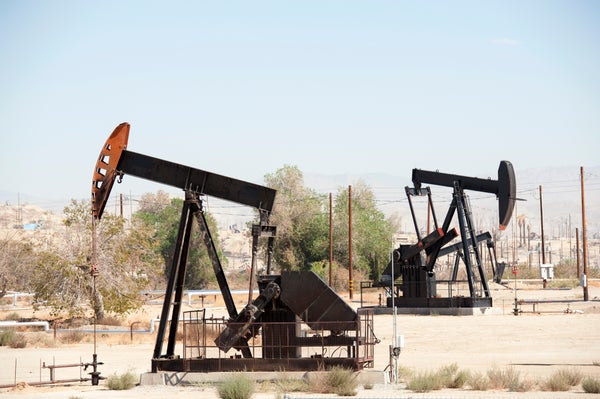
A new study by the Environmental Defense Fund and a team of university scientists estimates that the U.S. oil and gas industry emits 13 million metric tons of methane into the atmosphere each year, losing $2 billion annually from over 400 leak-prone drilling and processing facilities.
The losses, according to the study published yesterday in the journal Science, are 60 percent more than those estimated by EPA.
The studies “have transformed our understanding of methane emissions from natural gas systems in the United States,” said David Allen, a drilling expert at the University of Texas, who was one of 19 co-authors of the paper.
On supporting science journalism
If you're enjoying this article, consider supporting our award-winning journalism by subscribing. By purchasing a subscription you are helping to ensure the future of impactful stories about the discoveries and ideas shaping our world today.
Methane, the main component of natural gas, is a major greenhouse gas with more than 80 times the climate warming power of carbon dioxide measured over a 20-year time span. According to EDF, the researchers found that 2.3 percent of the gas produced is leaked into the air. That’s more than estimates by EPA, which found a 1.4 percent leak rate.
The additional lost gas would be enough to heat 10 million U.S. homes, according to EDF.
Steven Hamburg, EDF’s chief scientist who has led its five-year methane leak investigation, said it amounts to a “huge problem, but also an enormous opportunity.” In a press statement, he said that reducing the industry’s methane leaks would be “the fastest, most cost-effective way we have to slow the rate of warming today.”
EDF noted that the International Energy Agency estimates that worldwide the industry could reduce its emissions by 75 percent and that two-thirds of the leaks could be plugged “at zero net cost.”
Jeff Peischl, a scientist from the Cooperative Institute for Research in Environmental Sciences, a partnership between Colorado University and NOAA, said the climate impact of the oil and gas industry’s leaks was “roughly the climate impact of carbon dioxide emissions from all U.S. coal-fired power plants” operating in the United States in 2015.
He called the new study “the best estimate to date on the climate impact of oil and gas activity in the U.S.” Colm Sweeney, an atmospheric scientist in NOAA’s Global Monitoring Division, said, “Identifying the biggest leakers could substantially reduce emissions we have measured.”
In December, the American Petroleum Institute announced what it called “a landmark partnership” among its members, a voluntary program that would focus initially on reducing methane leaks and emissions of volatile organic compounds.
EDF noted in its statement yesterday that Exxon Mobil Corp. has committed to cut methane emissions along with Royal Dutch Shell PLC, Qatar Petroleum and other producers. EDF recently announced plans to launch a space satellite—“MethaneSAT”—to measure and map human-caused methane emissions almost anywhere on Earth.
Reprinted from Climatewire with permission from E&E News. E&E provides daily coverage of essential energy and environmental news at www.eenews.net.