
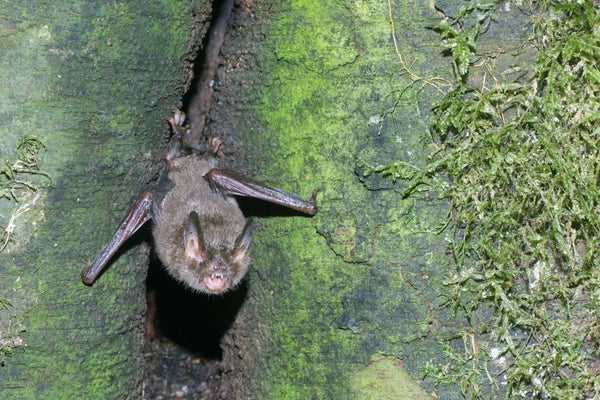
Under the night sky deep in a northern New Zealand forest, doctoral student Cory Toth is listening. The sound he is searching for—so high-pitched that Toth’s older colleagues can’t hear it—belongs to a whiskered creature local to the area: the New Zealand lesser short-tailed bat.
After a few months’ searching in the remote forest and a distracting discovery of tinnitus, Toth found the burrows and tunnels where the bats spend their nights. Additional field research and analysis revealed the species of bat not only sings, but also produces the most song output of any mammal studied to date. “What a fascinating bat!” says Mirjam Knörnschild, a behavioral ecologist at the Free University of Berlin who has studied acoustic communication in bats, and was not involved in the work. She marveled at the animals’ high vocal output, noting how few studies on bat vocalization there have been.
For an average of six hours at a time, the fuzzy-haired males exercise their vocal cords and produce about 100,000 syllables. Before Toth and his mentor, Stuart Parsons, both then at the University of Auckland, made their finding the whip-poor-will bird held the crown for the mammal with the highest song output, with 21,000 syllables.
On supporting science journalism
If you're enjoying this article, consider supporting our award-winning journalism by subscribing. By purchasing a subscription you are helping to ensure the future of impactful stories about the discoveries and ideas shaping our world today.
<<Can you hear it? Sample of lekking male song.>>
The bats (Mystacina tuberculata), which Toth describes as having “this kind of cute and intelligent look about them,” appear to use the songs to attract females flying by. Syllable output, a show of muscle and vocal cord strength, is an indicator of the singer’s size and overall energy. He says females “cruising through the area” use the song to guide their mating decisions. Toth, now a research assistant at Boise State University, and Parsons detailed their findings in a study published Wednesday in Behavioral Ecology and Sociobiology.
“It’s hard for us to appreciate just how complicated these mammalian communication behaviors are,” says Michael Smotherman, who directs a lab focused on bats at Texas A&M University in College Station and did not take part in the study. Bats are one of three distantly related groups of mammals—the other two are humans and cetaceans—known to have vocal learning abilities. Yet of the roughly 1,300 identified bat species, few have been comprehensively studied. Smotherman lamented the disparity in the number of acoustic studies conducted on bats compared with birds.
During the New Zealand lesser short-tailed bat’s breeding season, a significant period of its waking hours are spent working to attract a mate. Researchers and bat enthusiasts colloquially refer to it as the lekking bat, after the lek ritual: With tubular nostrils and protruding ears, the males congregate in a concentrated area where females are known to fly by, then begin to sing. What further distinguishes the New Zealand lekking bat is its habit of going through this mating ritual while crawling in burrows on the ground. The bat adapted to life on the ground because it first arrived in the area between 25 million and 30 million years ago, when the island nation did not have predatory mammals. Smotherman likens the lekking mating to the way young teenage boys go to shopping malls, stand in groups and make noise to attract attention. He calls it “doing the lekking.”
Applying bat behavior to humans is tempting. When Toth first began studying the lekking bat at Auckland in the early 2010s, he edited together video footage his team had collected of the bats landing in tree burrows and singing into a music video for the Daft Punk song, “Get Lucky.” But five years since his foray into music videos, he cautioned against applying any of his most recent findings to try to better understand human mating rituals and behavior. He also acknowledges a limitation of his and Parsons’s research is rooted in human classification. Whereas people distinguish syllables and song as significant, bats may have an entirely different way of understanding and utilizing these sound characteristics.
During the course of his research, Toth worked with volunteers to catch and electronically tag 16 bats. He also studied the locations the bats would go to practice their lekking ritual and installed sensors, high-frequency microphones and cameras along the burrows and tunnels where they sing. Each time a tagged bat would enter one of these burrows, the microphones and cameras would begin rolling. Some of the bats studied shared burrows whereas others had their own. After measuring sound frequencies, Toth concluded the bats that produced more syllables tended to be the independent occupants whereas those that produced fewer lived in what he and his supervisor called “time-share burrows.” The more syllables the male bat produces, the more attractive he is likely to be to a female, Toth says. The time-share occupants appear to strategically gather in groups so they can compensate for their lesser syllable output. When Toth cross-referenced this information with the measurements he had taken of the tagged bats, he found the bats that produce more syllables have smaller wingspans.
Having smaller wingspans appears to mean mating advantages. But Toth and Parsons want more evidence. Another member of Parsons’ lab, graduate student Kathleen Collier, is continuing to examine whether the bats’ syllable output, wingspan and mating attractiveness are related. Collier is building a speaker system that mimics the songs of the lekking bat with an even higher syllable output. The faux bat will be planted in a burrow in the forest and the researchers will spend the following months observing whether females visit that burrow more than others.
While the work on the lekking bat continues in New Zealand, the only region the now endangered species is found, Toth is studying another species closer to home in Wyoming’s Grand Teton National Park. His team is examining how bats react to human-manufactured light, and are hoping to push the national park to switch their lighting to red LED-bulbs that are less harmful to the animals. “Just from an ecology perspective, it makes sense,” Toth says.
Aside from singing, bats have many other intriguing qualities: They are the second-most diverse group of mammals on Earth, they have amazing social lives and they use the planet’s magnetic field to travel huge distances, Toth notes. “They are an amazing group of mammals that the general public doesn’t know much about.”