
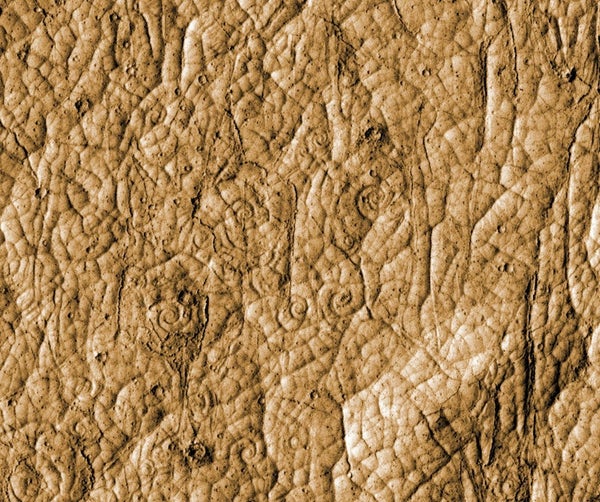
In his poem "Fire and Ice," Robert Frost explores whether the world will have a fiery or an icy ending. Scientists who study Mars have been engaged in a similar debate, except their discussion centers on origins rather than endings. For more than a decade, scientists have wondered whether the craggy plains of the Red Planet's Athabasca Valles arose from the actions of lava or ice. Now scientists at Arizona State University think they have an answer.
Athabasca Valles is a 300-kilometer-long series of valleys located in Mars's equatorial region. It is marked by carved channels and polygon-shaped plates, and scientists aren't sure how they formed. The patterns could be indicative of ice-related stress, where seasonal melting and freezing fragments the rock. Alternatively, the same features could arise when cooling lava forms a thin crust on the surface. As the inner lava cools and hardens, it tears the crust into polygons. Both theories have found support from the scientific community.
Now NASA's Mars Reconnaissance Orbiter has delivered high-resolution images of the Athabasca Valles that reveal 269 spiral-shaped rock formations. The spirals are similar to the rocky coils that form during earthly lava flows, providing strong evidence the valleys' origins are volcanic. In a paper in Science, the researchers hypothesize that, as the lava crust hardened and broke into plates, the still-molten lava beneath it came spiraling upward through the cracks, and in some cases solidified.
On supporting science journalism
If you're enjoying this article, consider supporting our award-winning journalism by subscribing. By purchasing a subscription you are helping to ensure the future of impactful stories about the discoveries and ideas shaping our world today.
In contrast, water is not viscous enough to freeze into such spirals. "There are no known mechanisms to naturally produce spiral patterns in ice-rich environments on the scale and frequency observed in our study area," the researchers wrote.
Which is to say that, at least for the formation of the Athabasca Valles, ice probably would not suffice.
—Sarah Fecht