
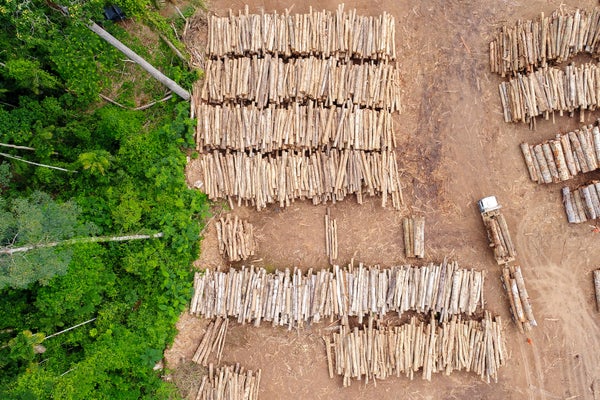
Study after study has sounded the alarm on the deteriorating Amazon rainforest. Plagued by deforestation, drought, fires and other human disturbances, the iconic ecosystem is teetering on a dangerous precipice, scientists warn.
New research is once again driving the point home. A pair of studies published this week in the journal Science conclude that the mighty Amazon is swiftly transforming—and it may be at risk of collapsing into a new kind of ecosystem altogether.
Human disturbances have degraded more than a third of the Amazon rainforest, the first study finds. Fires; selective logging; habitat fragmentation; and drought, which is worsened by climate change, are all chipping away at one of the world’s most iconic ecosystems.
On supporting science journalism
If you're enjoying this article, consider supporting our award-winning journalism by subscribing. By purchasing a subscription you are helping to ensure the future of impactful stories about the discoveries and ideas shaping our world today.
That’s to say nothing of the forest that’s been clearcut in recent decades.
The first study focuses only on degradation, activities that damage the forest but don’t remove all the trees from the landscape. It doesn’t include deforestation, which clears a forest area. That’s another problem entirely, with recent estimates suggesting that as much as 17 percent of the Amazon has already been cleared.
Degradation tends to get less attention than deforestation, the researchers note. But it’s still a serious threat. Even though trees remain standing, degraded forests are often less resilient to future disturbances. This puts them at greater risk of dying and transforming into different kinds of ecosystems, like grasslands. Degraded forests also tend to store less carbon.
The researchers used satellite data to estimate the extent of forest area affected by four major disturbances: droughts; fires; timber extraction, when trees are selectively logged from inside the forest without clearing the entire landscape; and “edge effects,” which is when the edges of a forest become more vulnerable to disturbances. Edge effects are common in forests that have been broken up into smaller and smaller pieces over time, with more edges overlapping roads, agricultural lands and other human disruptions.
They found that 38 percent of the remaining Amazonian forests are suffering from some form of degradation.
Often, multiple different disturbances act on the same tract, the study finds. About 5.5 percent of the Amazon is suffering from the combined effects of timber extraction, fire and edge effects at once.
The second study underscores the powerful impact of human activity in the Amazon. It finds that human disturbances are altering the ecosystem hundreds to thousands of times faster than natural processes change the landscape.
The study pulls much of its data from a recent assessment report compiled by the Science Panel for the Amazon, an initiative convened by the United Nations' Sustainable Development Solutions Network. It notes that about 17 percent of the original Amazon has already been deforested. About 14 percent has been converted into agricultural land.
“As we approach an irreversible tipping point for Amazonia, the global community must act now,” the authors of the second study wrote. “To fail the Amazon is to fail the biosphere, and we fail to act at our own peril.”
Scientists have warned repeatedly that the collapse of the Amazon rainforest ecosystem would be a global catastrophe. The Amazon is among the most biodiverse ecosystems on Earth, estimated to contain at least 10 percent of all the world’s plant and vertebrate animal species in one place.
It also contains vast stores of carbon, locked up in its trees and soil. Research estimates that the entire Amazon ecosystem may contain as much as 180 billion tons of carbon — that's about a quarter of all the carbon that's entered the atmosphere since the Industrial Revolution began. As the Amazon degrades, it releases more carbon into the atmosphere, which hastens the progression of global climate change.
Research says that parts of the Amazon are already flipping from carbon sinks to carbon sources, meaning they emit more carbon into the atmosphere than they absorb.
As the ecosystem continues to degrade, scientists say that it may eventually reach a tipping point — a kind of threshold beyond which the Amazon can no longer recover from its disturbances. After this tipping point, the Amazon may transform from a lush rainforest into a grassy savanna — a drier and much less biodiverse kind of ecosystem.
It’s been difficult for scientists to find the precise location of this tipping point. But another recent study warned that it could be approaching faster than expected. It finds that the Amazon has been steadily losing its resilience — its ability to recover from disturbances — for at least 20 years (Climatewire, March 8, 2022).