Onward, Intrepid Rover

Scientific American Space & Physics April-May 2021

Scientific American Space & Physics April-May 2021

Join Our Community of Science Lovers!

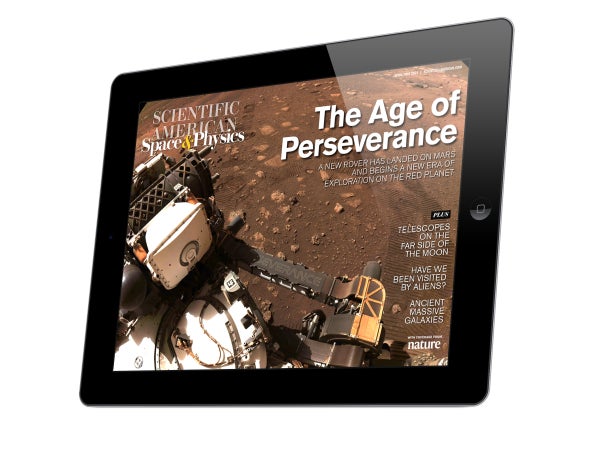
In 2008 an engineer friend of mine helped to design the sky crane that lowered the Curiosity rover from the hovering rocket to the surface of Mars. In commemoration, his signature was engraved on a small plaque on the device. Thirteen years later this past February, that same crane design helped to successfully land Perseverance in the Jezero Crater on the Red Planet. Our space and physics senior editor Lee Billings and journalist Jonathan O’Callaghan report on this remarkable achievement and detail the tall order of tasks ahead for the fifth robotic visitor to Mars (see “Perseverance Has Landed! Mars Rover Begins a New Era of Exploration” and “The First 100 Days on Mars: How NASA’s Perseverance Rover Will Begin Its Mission”).

This time Perseverance is bringing with it nearly 11 million names from Earth to our neighboring planet—each name stenciled on a silicon chip installed on the rover’s body. Like scraps of paper folded inside bottles floating across the ocean, these little pieces of our humanity—our names—have been flung far from the surface of our home planet. Perhaps the goal is the same: to connect, even in a small way, with whatever is found on the other side. Godspeed, intrepid explorers!

Andrea Gawrylewski is chief newsletter editor at Scientific American. She writes the daily Today in Science newsletter and oversees all other newsletters at the magazine. In addition, she manages all special editions and in the past was the editor for Scientific American Mind, Scientific American Space & Physics and Scientific American Health & Medicine. Gawrylewski got her start in journalism at the Scientist magazine, where she was a features writer and editor for "hot" research papers in the life sciences. She spent more than six years in educational publishing, editing books for higher education in biology, environmental science and nutrition. She holds a master's degree in earth science and a master's degree in journalism, both from Columbia University, home of the Pulitzer Prize.

More by Andrea Gawrylewski
SA Space & Physics Vol 4 Issue 2This article was published with the title “Onward, Intrepid Rover” in SA Space & Physics Vol. 4 No. 2 ()
doi:10.1038/scientificamerican042021-TLsa46HHZwYfa4eehEpeq

It’s Time to Stand Up for Science

If you enjoyed this article, I’d like to ask for your support. Scientific American has served as an advocate for science and industry for 180 years, and right now may be the most critical moment in that two-century history.

I’ve been a Scientific American subscriber since I was 12 years old, and it helped shape the way I look at the world. SciAm always educates and delights me, and inspires a sense of awe for our vast, beautiful universe. I hope it does that for you, too.

If you subscribe to Scientific American, you help ensure that our coverage is centered on meaningful research and discovery; that we have the resources to report on the decisions that threaten labs across the U.S.; and that we support both budding and working scientists at a time when the value of science itself too often goes unrecognized.

In return, you get essential news, captivating podcasts, brilliant infographics, can't-miss newsletters, must-watch videos, challenging games, and the science world's best writing and reporting. You can even gift someone a subscription.

There has never been a more important time for us to stand up and show why science matters. I hope you’ll support us in that mission.

Thank you,

David M. Ewalt, Editor in Chief, Scientific American

Subscribe