
On supporting science journalism
If you're enjoying this article, consider supporting our award-winning journalism by subscribing. By purchasing a subscription you are helping to ensure the future of impactful stories about the discoveries and ideas shaping our world today.
It's hard to keep oxygen molecules around, despite the fact that it's the third-most abundant element in the universe, forged in the superhot, superdense core of stars. That's because oxygen wants to react; it can form compounds with nearly every other element on the periodic table. So how did Earth end up with an atmosphere made up of roughly 21 percent of the stuff?
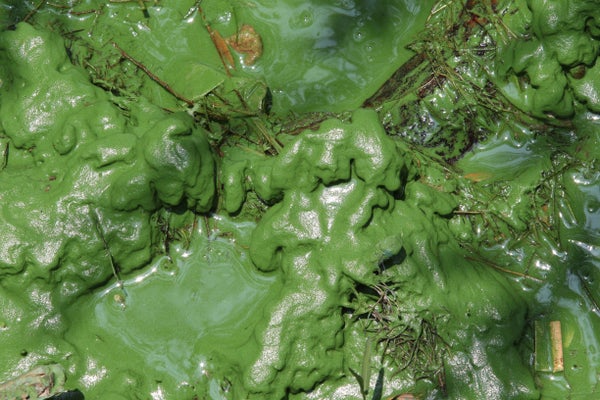
The answer is tiny organisms known as cyanobacteria, or blue-green algae. These microbes conduct photosynthesis: using sunshine, water and carbon dioxide to produce carbohydrates and, yes, oxygen. In fact, all the plants on Earth incorporate symbiotic cyanobacteria (known as chloroplasts) to do their photosynthesis for them down to this day.
For some untold eons prior to the evolution of these cyanobacteria, during the Archean eon, more primitive microbes lived the real old-fashioned way: anaerobically. These ancient organisms—and their "extremophile" descendants today—thrived in the absence of oxygen, relying on sulfate for their energy needs.
But roughly 2.45 billion years ago, the isotopic ratio of sulfur transformed, indicating that for the first time oxygen was becoming a significant component of Earth's atmosphere, according to a 2000 paper in Science. At roughly the same time (and for eons thereafter), oxidized iron began to appear in ancient soils and bands of iron were deposited on the seafloor, a product of reactions with oxygen in the seawater.
"What it looks like is that oxygen was first produced somewhere around 2.7 billion to 2.8 billon years ago. It took up residence in atmosphere around 2.45 billion years ago," says geochemist Dick Holland, a visiting scholar at the University of Pennsylvania. "It looks as if there's a significant time interval between the appearance of oxygen-producing organisms and the actual oxygenation of the atmosphere."
So a date and a culprit can be fixed for what scientists refer to as the Great Oxidation Event, but mysteries remain. What occurred 2.45 billion years ago that enabled cyanobacteria to take over? What were oxygen levels at that time? Why did it take another one billion years—dubbed the "boring billion" by scientists—for oxygen levels to rise high enough to enable the evolution of animals?
Most important, how did the amount of atmospheric oxygen reach its present level? "It's not that easy why it should balance at 21 percent rather than 10 or 40 percent," notes geoscientist James Kasting of Pennsylvania State University. "We don't understand the modern oxygen control system that well."
Climate, volcanism, plate tectonics all played a key role in regulating the oxygen level during various time periods. Yet no one has come up with a rock-solid test to determine the precise oxygen content of the atmosphere at any given time from the geologic record. But one thing is clear—the origins of oxygen in Earth's atmosphere derive from one thing: life.
