
“Women and lowly men are so hard to handle. If you let them too close to you, they become disobedient. But if you keep them at a distance, they become resentful,” Confucius is quoted as saying in the Analects, a collection dating back to the fifth century B.C. Confucius did not invent gender bias, of course, nor did he devise its systemic expression in patriarchy. But the answer to when the concentration of social power in men first arose, and why, may lie in the bones of his ancestors.
The clue shows up in connective tissue, or collagen, examined during a recent study involving bones from 175 Neolithic and Bronze Age people who lived in China. A carbon signature in this protein suggests the types of grains the people consumed, and a nitrogen signature reveals the proportion of meat in their diet, according to research published in January in the Proceedings of the National Academy of Sciences USA.
The bone chemistry indicates that male and female diets were similar during the Neolithic period, which started about 10,000 years ago and in which agriculture began. Both sexes ate meats and grains. “During early farming, females contributed a lot to food production. [Men and women] eat the same things, and they're of more or less equal standing,” says Kate Pechenkina, an archaeologist at Queens College, City University of New York, and senior author on the paper.
On supporting science journalism
If you're enjoying this article, consider supporting our award-winning journalism by subscribing. By purchasing a subscription you are helping to ensure the future of impactful stories about the discoveries and ideas shaping our world today.
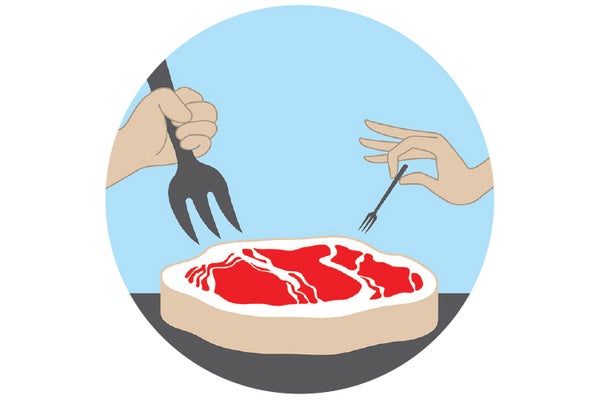
The menu shift began at the end of the Neolithic and continued through the Bronze Age, often estimated to have begun in China around 1700 B.C. People there increasingly planted wheat, which leaves a carbon signature distinct from that of the millet they had already been growing. The osteoanalysis shows that between 771 and 221 B.C. men continued eating millet and meat—but the latter disappeared from women's diets and was replaced with wheat. Women's bones also began showing cribra orbitalia, a type of osteoporosis and an indicator of childhood malnutrition. “It means already from early childhood, young girls are treated very poorly,” Pechenkina says.
Some anthropologists have a theory for why the balance of power tipped just as wheat was introduced, as well as other commodities such as cattle and bronze. These new resources afforded opportunities for wealth to accumulate and may have provided an opening for men to take control of the novel foods and wares—and to use their new power to suppress women.
Violence may have played a role, too. “The [end of China's Bronze Age] is called the Warring States Period,” says Stanley H. Ambrose, an anthropologist at the University of Illinois at Urbana-Champaign, who was not involved with the study. In civilizations rife with bloodshed, a warrior class often inflates the value of men, Ambrose explains.
Early China, in particular, may have been primed for patriarchy. “If you're going to develop an empire that's expansive, whether a state in the Andes or in China, that's usually on the back of an army,” says Jane Buikstra, an archaeologist at Arizona State University, who was not involved with the study. She thinks that the ambitions of ancient Chinese dynasties, in cahoots with men seeking to control the new resources of the Bronze Age, may have all set the table for a culture of female subordination.
This theory should not be interpreted deterministically. Cultures might take different paths toward social inequality. And elements of these systems can be dismantled. For example, increasing pay parity may be leading to broadly diminishing gender bias in the Western world.
Nevertheless, the early bias evidence in China extends beyond bones. Women's graves started to include fewer burial treasures than men's during the Bronze Age, suggesting females were also treated poorly in death. “That argues it's a lifetime of [gender] distinction,” Buikstra says.