Voyage to Bennu and Back with OSIRIS-REx [Video]

NASA’s first sample-return mission to an asteroid could be vital for understanding life’s origins and shaping its future

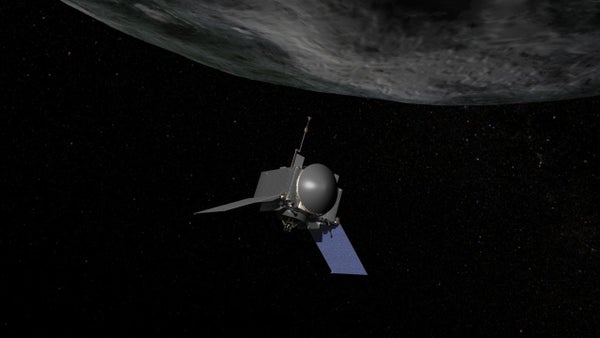
Artist concept of OSIRIS-REx at asteroid Bennu.

Join Our Community of Science Lovers!

In “To Bennu and Back” OSIRIS-REx principal investigator Dante S. Lauretta takes readers deep inside NASA’s sample-return mission to the asteroid Bennu.

As detailed in this video, Bennu is a carbonaceous asteroid, an ancient relic from the solar system’s infancy that is filled with organic molecules. Other asteroids like Bennu may have seeded the early, prebiotic Earth with this material, contributing to the primordial soup from which life eventually emerged. By studying the sizable and pristine sample of material OSIRIS-REx is expected to bring back to Earth from Bennu, scientists hope to unlock deep secrets about the origins of the terrestrial planets and of life itself.


On supporting science journalism

If you're enjoying this article, consider supporting our award-winning journalism by subscribing. By purchasing a subscription you are helping to ensure the future of impactful stories about the discoveries and ideas shaping our world today.


Morever, because Bennu has a slight-but-significant chance of striking our planet late in the 22nd century, it is also one of the most threatening asteroids known to humanity. Its orbit is evolving, pushed by the subtle influence of sunlight so that its exact future trajectory difficult to predict. As part of its preparation for gathering a sample, OSIRIS-REx will create detailed maps of Bennu’s surface and characterize its slowly evolving orbit with unprecedented precision, allowing researchers to better forecast its future movements and plan ways to deflect it away from Earth. The experience gained from OSIRIS-REx’s operations at Bennu could also pave the way for future efforts to mine valuable resource from asteroids.

After launching in September 2016, OSIRIS-REx will arrive at Bennu in August 2018, and will spend roughly two years at the asteroid before gathering its sample. At Bennu, decades of effort and investment will culminate in a five-second “touch and go” maneuver in which OSIRIS-REx autonomously descends to a collection site and quickly gathers a sample before rocketing back into orbit. After a 2.5-year journey back to Earth, the spacecraft will jettison its precious cargo in a reentry capsule that will drift down to Earth on parachutes in late 2023.

Lee Billings is a science journalist specializing in astronomy, physics, planetary science, and spaceflight and is senior desk editor for physical science at Scientific American. He is author of a critically acclaimed book, Five Billion Years of Solitude: The Search for Life Among the Stars, which in 2014 won a Science Communication Award from the American Institute of Physics. In addition to his work for Scientific American, Billings’s writing has appeared in the New York Times, the Wall Street Journal, the Boston Globe, Wired, New Scientist, Popular Science and many other publications. Billings joined Scientific American in 2014 and previously worked as a staff editor at SEED magazine. He holds a B.A. in journalism from the University of Minnesota.

More by Lee Billings
Scientific American Magazine Vol 315 Issue 2This article was published with the title “Voyage to Bennu and Back with OSIRIS-REx [Video]” in Scientific American Magazine Vol. 315 No. 2 ()
doi:10.1038/scientificamerican082016-5edMsFbMaMbAMg0KywPPmS

It’s Time to Stand Up for Science

If you enjoyed this article, I’d like to ask for your support. Scientific American has served as an advocate for science and industry for 180 years, and right now may be the most critical moment in that two-century history.

I’ve been a Scientific American subscriber since I was 12 years old, and it helped shape the way I look at the world. SciAm always educates and delights me, and inspires a sense of awe for our vast, beautiful universe. I hope it does that for you, too.

If you subscribe to Scientific American, you help ensure that our coverage is centered on meaningful research and discovery; that we have the resources to report on the decisions that threaten labs across the U.S.; and that we support both budding and working scientists at a time when the value of science itself too often goes unrecognized.

In return, you get essential news, captivating podcasts, brilliant infographics, can't-miss newsletters, must-watch videos, challenging games, and the science world's best writing and reporting. You can even gift someone a subscription.

There has never been a more important time for us to stand up and show why science matters. I hope you’ll support us in that mission.

Thank you,

David M. Ewalt, Editor in Chief, Scientific American

Subscribe