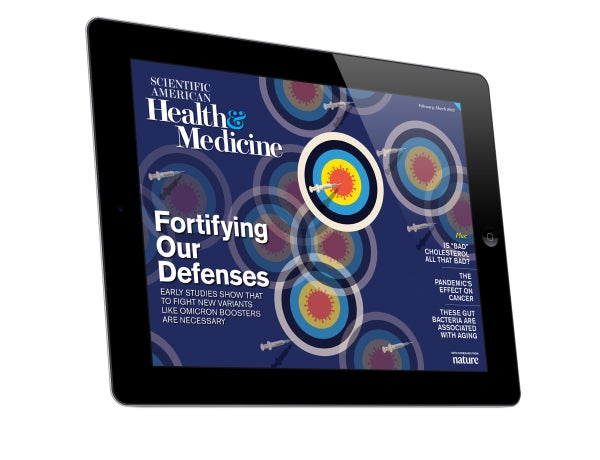
Scientific American Health & Medicine, February/March 2022
Join Our Community of Science Lovers!
On supporting science journalism
If you're enjoying this article, consider supporting our award-winning journalism by subscribing. By purchasing a subscription you are helping to ensure the future of impactful stories about the discoveries and ideas shaping our world today.
Vaccines remain the strongest protection against severe illness and death from COVID, even as the Omicron variant runs like wildfire through the U.S. population. In fact, as Ewen Callaway reports, a booster shot of the Pfizer vaccine is holding strong against serious cases of the disease according to early reports (see “Omicron Is Likely to Weaken COVID Vaccine Protection—but Boosters Could Restore It”). Vaccines are also the best bet for protecting children and help to reduce transmission (see “The Benefits of Vaccinating Kids against COVID Far Outweigh the Risks of Myocarditis”). The take-home message is that the vaccines work and that as many of us who can get them should.
Also in this issue, reporter Natalie Healey takes a close look at one of the long-held beliefs about hearth health (see “Is There More to a Healthy-Heart Diet Than Cholesterol?”). And a growing list of successful treatments is coming out of gene therapy, as journalist Jim Daley writes (see “Four Success Stories in Gene Therapy”). As always, here’s to your health.
Subscribe to Support Independent Journalism
Great science journalism requires human expertise, time, effort and creativity. And it costs money. That’s why I and the journalists here at Scientific American hope you’ll join our community.
When you subscribe, you are supporting staff and freelance journalists who are passionate about telling science stories that are true, important and compelling. Our editors and reporters are often experts in their fields, which means they understand the nuances of big discoveries and can untangle the breakthroughs from the hype. With a subscription, you are also supporting rigorous fact-checking to ensure the words we publish are precise and accurate. And you’re supporting original illustrations, graphics and photos that bring you closer to an advanced laboratory, an ice sheet in Antarctica or a space mission in orbit. You’re helping us craft other types of high-quality journalism as well: Our newsletters are carefully written, edited and curated by staffers you have or will come to know and love. Our Science Quickly podcast is based on original reporting, collaboration with editors and scientists and exacting production.
Subscriptions keep this engine running so we can continue to deliver thoughtful, rigorous and independent science journalism to you. In an era of viral misinformation, this work is crucial. If you value what we do, I hope you’ll consider joining us as a subscriber
Thank you,
Jeanna Bryner, Editor in Chief, Scientific American