
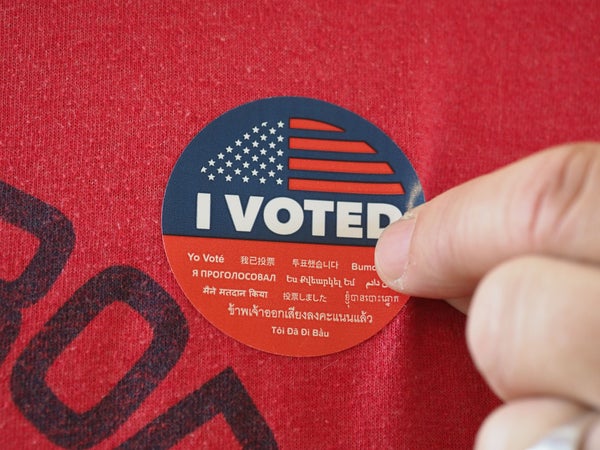
A decisive experiment for science is going to take place on November 6 in which millions of American voters are expected to participate.
With early voting already begun in some states, the midterm election will determine whether Democrats or Republicans will control each of the two chambers of Congress and have the task of checking or supporting Pres. Donald Trump’s agenda for the rest of his term. Science is at the core of several of the most divisive issues voters will weigh in on. During the past several months Scientific American has been digging not only into the details of these issues but also the nuances of their politics. Below is a roundup of some of our most important coverage.
As our editors wrote in the November issue, the U.S. government has repeatedly ignored scientific evidence and used an anti-science approach to dictate regulations that affect human health and the environment. In one case, Trump himself challenged scientific consensus and said the planet’s changing climate is only part of a natural warming period—although the data says otherwise.
On supporting science journalism
If you're enjoying this article, consider supporting our award-winning journalism by subscribing. By purchasing a subscription you are helping to ensure the future of impactful stories about the discoveries and ideas shaping our world today.
Research suggests a possible outcome of the midterm elections could be a further emboldened Trump, despite his tenuous relationship with facts. Surprisingly, leaders who lie strike some as more appealing and authentic. Sociologists have found, for example, that bald-faced lies may be interpreted as a challenge, a symbolic protest, against the political establishment. Those leaders may be particularly irresistible for people who tend to respond aggressively when treated unfairly and have little empathy for others, as columnist Scott Barry Kaufman surmises.
The way we’re raised can also influence whom we vote for. Psychological studies show liberals act in individualistic ways, like Western, educated, industrialized, rich and democratic cultures—adequately called WEIRD. Conservatives, in contrast, think more like non-Western cultures that value social ties. Interestingly, in the U.S. at least, people’s tweets are a good indication of their political alignments: Democrats usually swear like sailors, Republicans tend to bring up religion.
But our attitudes toward politics are not only rooted in our culture, they might be encoded in our genes as well. Scientists have started finding genetic variants associated with extroversion and novelty seeking in highly liberal women, for example. The evidence is still scarce, but it indicates that political inclinations may be written in people’s DNA and likely inherited by future generations.
The science behind partisanship, however, should not be taken as an excuse to split friendships and ruin family holidays. The savage battles between left and right in the U.S. and elsewhere can blind citizens from voting for public policies based on their actual content—including policies we don’t necessarily agree with. In fact, psychologists think strongly labeling ourselves as liberals or conservatives leads us nowhere but to more divisiveness.
In the past few years the political climate has sprung an unprecedented defense of scientific truth all around the world. It’s a reminder that science (and yes, scientists) has always been political. Marie Curie famously opposed authoritarian regimes and Stephen Hawking supported universal health care. But recent marches and protests have only gotten us so far. It is by voting (or, some would argue, not voting at all) that citizens can best protect science for the public good.
Elections can be seen as huge social experiments, but sadly they can be tinkered with maliciously, as our contributor David Noonan reports. Researchers have determined simple statistical methods to detect possible signs of ballot stuffing and voter rigging. When it comes to U.S. elections, though, restricted access to data at the state level makes them harder to analyze.
Tuesday’s experiment will test if Americans are willing to permit their officials to shy away from knowledge-based decisions. Their vote will no doubt shape the future of the country and its democratic system. Whether the role of science is valued or ignored is now each person’s choice.