
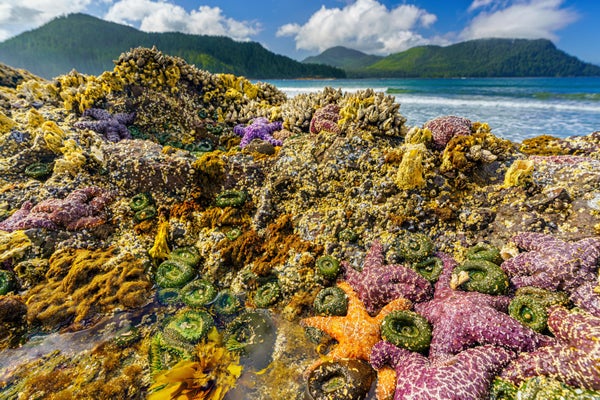
More than 1 billion sea creatures along the Vancouver coast were cooked to death during a record-breaking heat wave in the Pacific Northwest, according to preliminary data.
The maritime massacre surprised even the experts. Christopher Harley, a professor at the University of British Columbia, said the death toll kept climbing as his team investigated area beaches.
“I was on a shore just as the tide was falling on the first of the three hot days. I was not thinking to myself, ‘All of these things will probably be dead by Monday afternoon,’” Harley said. “I didn’t realize that I would spend most of the next few weeks madly dashing around the province to document such unprecedented impacts.”
On supporting science journalism
If you're enjoying this article, consider supporting our award-winning journalism by subscribing. By purchasing a subscription you are helping to ensure the future of impactful stories about the discoveries and ideas shaping our world today.
After a four-day period in June when temperatures in the Pacific Northwest shattered records and broke 100 degrees Fahrenheit, Harley and his team visited shorelines to count the damage to sea creatures such as mussels and rockweed. Those species are typically the first to wash ashore as they die.
Last week, they estimated 1 billion dead sea animals. This week, they’re saying it could be more than that.
The team estimated that on one site—Galiano Island, a strip of land between Vancouver Island and the lower mainland of British Columbia—1 million mussels died in an area the size of a tennis court.
A 1-kilometer area near White Rock is estimated to be a graveyard to 100 million barnacles, Harley said.
“The Strait of Georgia and Puget Sound have thousands of kilometers of coastline. Not all sites are as bad as the two I described, but you can fit a lot of tennis courts into a thousand kilometers,” he said.
Harley said they’ve found more dead sea species in the weeks after the rare heat wave. A species of snail called dogwhelk already has started washing up.
“The more shorelines I visit, the higher my estimate becomes,” he said. “The system is already responding.”
As they log more dead species across a greater number of habitats, Harley warned of the potential collapse of the region’s maritime ecosystem.
Losing a good number of mussels, he said, could destabilize local parts of the ocean, since they filter the water and provide food for other species such as starfish, crabs and birds. Rockweed also provides important habitat for other species.
Losing just those two species would cause biodiversity to decline, he said. And they aren’t finished counting yet.
“I also worry about the little things that most people—including biologists—don’t pay much attention to,” Harley added. “For most of the strange and wonderful creatures that call the mussel bed home, we don’t even know enough about them to know how many were lost and if and when they will recover.”
Harley said he’s received observations of die-offs from other researchers, shellfish growers and beachgoers as far south as Hood Canal in Washington and as far north as Klemtu in British Columbia.
This heat wave seemed to have hit the Salish Sea particularly hard, he said. But as global temperatures continue to rise, he expects more areas to feel the heat, too.
It could foreshadow a grim future.
“So far, my students and I have recorded dead animals on beaches that span hundreds of kilometers of shoreline,” he said. “Eventually, parts of the British Columbia coast may become more like Hong Kong and other hot parts of the world where many of the intertidal species die off every single summer.”
Reprinted from E&E News with permission from POLITICO, LLC. Copyright 2021. E&E News provides essential news for energy and environment professionals.