
Key concepts
Physics
Gravity
Weight
Civil engineering
Introduction
Have you ever walked, ridden your bike or driven in a car over a long bridge? Bridges have to be sturdy enough to support the weight of many people and cars without collapsing. One important part of designing a bridge is selecting the right materials. Another is making sure those materials comprising it are shaped in a way to make them strongest. In this project you will build a simple "bridge" using materials you already have on hand—paper and tape! Can you build a miniature bridge that doesn't collapse?
Background
If you take a piece of paper and try to bend or flex it, it will bend very easily. How hard it is to bend a material is referred to as the material's bending stiffness. A stiffer material will be harder to bend. But if you roll the paper tightly into a tube or fold it into an accordion shape, it becomes much harder to bend. Why does this happen? It is still the same material, but its shape also affects how easily it bends.
On supporting science journalism
If you're enjoying this article, consider supporting our award-winning journalism by subscribing. By purchasing a subscription you are helping to ensure the future of impactful stories about the discoveries and ideas shaping our world today.
Both the bending stiffness and the shape are very important for civil engineers to consider when designing bridges. Lots of cars drive over a bridge all at once, and cars are very heavy. If the bridge's bending stiffness is not high enough, it could sag under the weight of all the cars or even collapse! So, whether a bridge is made out of stone, wood, steel or another sturdy material, civil engineers still have to carefully consider its shape.
Materials
Four thick books (such as school textbooks, cookbooks, etcetera) that are roughly the same thickness
At least six pieces of construction paper
Scotch tape
Ruler or measuring tape
Preparation
Create two stacks of two textbooks each. Place them just under two feet apart from each other on a table, floor or other flat surface.
Line up two pieces of paper end to end, so the short edges are overlapping just slightly (by about a quarter of an inch). Use long strips of Scotch tape to bind the pieces of paper together on both sides. These two pieces of paper will make one "bridge."
Repeat this process for four more pairs of paper, so you can make five bridges total.
Procedure
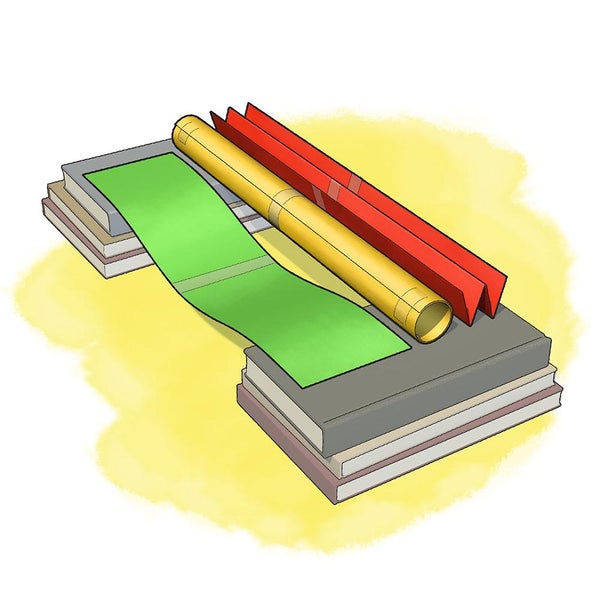
Take one of your taped-together bridges and lay an end on top of each pile of textbooks, with about half an inch of overlap. You might need to slide your textbooks closer together or farther apart a bit. What happens to the paper? Does it stay up in the air or sag down under its own weight?
Now take your next taped-together bridge. Tightly roll it into a long tube and use a few pieces of tape to hold the tube shut. Place the tube on top of your textbooks as you did before. What happens to the tube? Does it stay up or collapse?
Take your next taped-together bridge and fold it into a "W" shape lengthwise (meaning, when you look at the short end, you should see a W shape). Do this by folding in half lengthwise first, then folding each half again in the opposite direction (for a total of three fold lines, dividing the paper into four equal sections). Place the W shape on your textbooks like you did before. What happens this time?
What bridge stayed up best? Collapsed fastest?
Extra: Create two new bridges and come up with your own designs. What other shapes can you think of? Now test them out. How well did they fare compared with the first three bridges?
Extra: Put your bridges higher up, for example between two tables and chairs. Use some string and a plastic cup to hang weights from them. (You can use coins as weights.) Do certain shapes hold more weight than others?
[break]
Observations and results
You should have found that the flat pieces of paper bent very easily and sagged down under their own weight. Bending or rolling the pieces of paper, however, increases their bending stiffness quite a bit, allowing them to form a bridge between the stacks of textbooks. Try to look around you for examples of this principle in everyday life. For example, you might have desks and chairs at school with metal legs. Are the legs flat pieces of metal or are they tubes? Why do you think cylindrical tubes might be better for supporting the weight of a person than flat pieces?
More to explore
Bridge Science Project Ideas, from Science Buddies
Feel the Forces of a Suspension Bridge, from Scientific American
Bridge Facts, from Science Kids
Science Activities for All Ages!, from Science Buddies
This activity brought to you in partnership with Science Buddies

Special thanks to Margot Vigeant at Bucknell University for this idea