
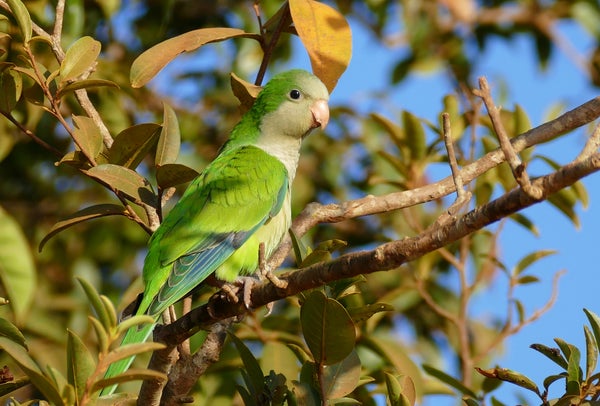
Small, emerald-coloured birds called monk parakeets (Myiopsitta monachus) invaded Mexico in the span of a decade because of trade policies thousands of kilometres away in Europe, according to a study released this month. The research highlights how fears over avian flu, which prompted a ban on bird imports in Europe, had wide ranging effects in other countries.
Monk parakeets, a type of parrot native to South America, popped up in countries such as the United States in the 1960s and have established themselves from Brooklyn to Brussels. There were only a handful of reported sightings of the bird in Mexico City in 2005. But by 2015, feral monk parakeets were documented in 97 cities throughout the country, say researchers in a study published on 19 September in PLoS ONE. Monk parakeets are considered agricultural pests, and their enormous communal nests can cause blackouts when built on electrical equipment. But they are popular as pets, and so have been part of the international parrot trade.
“It’s been a really, really fast invasion,” says Elizabeth Hobson, a behavioural ecologist at the Santa Fe Institute in New Mexico and lead author on the study, both in terms of the geographic scope and the shifts in the trade policies that contributed to it. Usually, it’s hard to work out when a non-native species first appeared in an area, says Hobson. But the arrival of monk parakeets in Mexico has a sharply defined start and end point, thanks to shipping documentation and bird sightings recorded by citizen scientists using apps such as iNaturalist and eBird, Hobson says.
On supporting science journalism
If you're enjoying this article, consider supporting our award-winning journalism by subscribing. By purchasing a subscription you are helping to ensure the future of impactful stories about the discoveries and ideas shaping our world today.
Unintended consequences
She and her colleagues contend that two pieces of legislation shifted the global demand for monk parakeets from Europe to Mexico. In 2004, concerns about the spread of avian influenza in Europe led to an import ban on birds from southeast Asia. By 2007, the European Union had banned the importation of all wild-caught birds, regardless of their origin.
As EU demand for monk parakeets crashed, the international market for the birds shifted to Mexico, where regulatory changes in 2008 had made it illegal to purchase native Mexican parrots as pets, in an effort to preserve wild population numbers. The monk parakeet was one of the few options left for people who wanted to lawfully purchase a parrot.
More than half a million monk parakeets were imported into Mexico as part of the pet trade between 2000 and 2015. Hobson and her colleagues used international trade data to determine that 90% of those birds entered Mexico starting in 2008 and ending in 2014, mostly from Uruguay. The increase in wild monk-parakeet sightings throughout Mexico roughly coincided with the changes in regulations and commercial imports.
“This whole invasion seems like it was just a fascinating series of unforeseen consequences of regulation changes,” says Hobson. It’s important to think about how policy changes can both protect human populations and have unexpected negative results—such as the introduction of an invasive species, she says.
Setting a baseline
Mexico stopped its commercial imports of monk parakeets in 2014 over concerns about the possible spread of avian influenza. The country declared the monk parakeet an invasive species in late 2016, and is required by law to devise a species management plan. This doesn’t necessarily mean the invasion is over, Hobson says, because there are a lot of monk parakeets in Mexico that can escape their owners and reproduce in the wild. It’s also still unclear what effect the animals are having on the country’s native wildlife, urban infrastructure and local economy.
The study’s findings punctuate the importance of banning the international trade in parrots, as well as the need for evaluating the unintended consequences of legislative and management action, says Michael Russello, an evolutionary biologist at the University of British Columbia in Kelowna, Canada.
The baseline data provided by the study “will be invaluable for tracking the spread and potential establishment of self-sustaining monk-parakeet populations in Mexico moving forward, and monitoring the performance of any management action”, Russello says.
This article is reproduced with permission and was first published on September 29, 2017.