
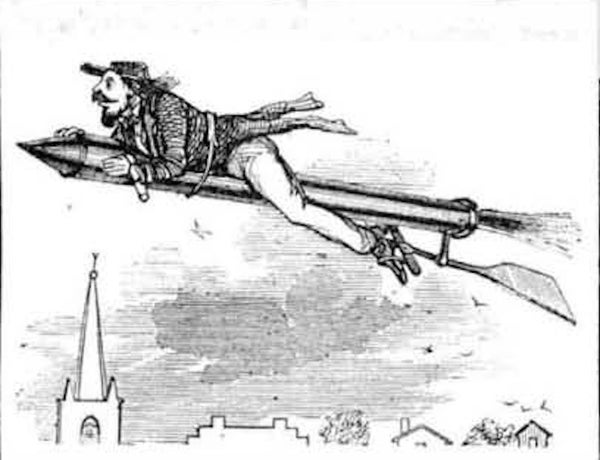
If we try and peer along the continuum of invention we can probably figure out that we will be able to communicate more easily, move faster, live longer and accomplish more work by relying more heavily on the increasingly powerful technical servants at our beck and call. When this magazine was founded in 1845, my forerunner might have climbed the rickety stairs to a cramped “7 by 9” office and penned these words with a fountain pen on cotton rag paper, which would have been carried to our printer (a few minutes’ walk away) for composition with movable type on a letter press (thanks to Johannes Gutenberg’s 15th-century invention). In 2016, an ear-popping elevator (invented 1852) whisks me up to the 46th floor of our office building, where I sit in front of a laptop computer and tap away for posting on the World Wide Web. In another 170 years my descendants might ... what? Their brain might connect directly with a galaxy-wide internet, but they might not “work” as we understand the concept now. They might not go anywhere, or they might never sit still.
The history of the future tends to say more about the optimism or pessimism of the writer at the time than about the advance of science. An enthusiastic look at the “gee-whizz” prospects lets us fantasize that we will travel more quickly, see better in the dark, live in a cleaner and more efficient city (perhaps those are my fantasies because I live in New York City). But there’s a darker side to science. Sometimes it is readily apparent—look at all the bad sci-fi movies—and sometimes it takes a while to recognize.
Eugenics was considered very favorably in the early 1900s—a way to improve society along sound scientific lines. But by 1934 one writer pointed out the realities of imposing a theory on actual people: “Our scant scientific eugenic knowledge has been prostituted to justify ancestor worship, race superiority, snobbery, class distinction, intellectual aristocracy, and race prejudice.” [June 1934]
On supporting science journalism
If you're enjoying this article, consider supporting our award-winning journalism by subscribing. By purchasing a subscription you are helping to ensure the future of impactful stories about the discoveries and ideas shaping our world today.
The nuclear age engendered some fear about the power of science in the hands of foolish humankind. One article from 1950, written in response to the development of the hydrogen bomb, suggested that we should redesign our cities to be able to survive nuclear cataclysm. [June 1950, image below]
And artificial intelligence, which scientists so diligently pursue, drew this veiled warning from Marvin Minsky in 1966: “It is unreasonable, however, to think machines could become nearly as intelligent as we are and then stop, or to suppose we will always be able to compete with them in wit or wisdom.” [September 1966]
But if we look past the frontiers of science, the “old universal truths” do not change, as William Faulkner pointed out in his acceptance speech in 1950 for the Nobel Prize for Literature: “love and honor and pity and pride and compassion and sacrifice.” If the trappings of our life change, the essence of what it means to be a human being does not—whether or not chimpanzees can also plan ahead to make and use tools.