
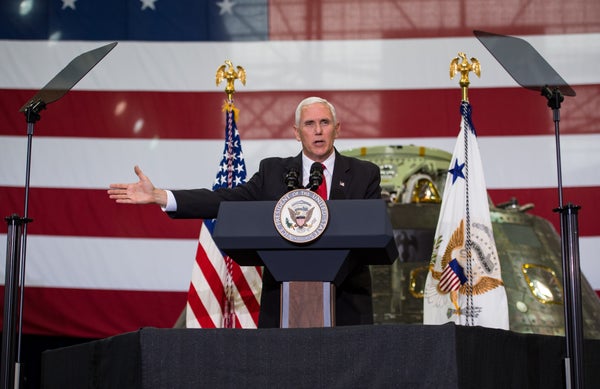

CAPE CANAVERAL, Fla. — The Trump administration will seek a heavier emphasis on human-spaceflight efforts, including crewed missions to the moon and Mars, Vice President Mike Pence said today (July 6).
During a 25-minute speech at NASA's Kennedy Space Center (KSC) here on Florida's Space Coast, Pence told the 700-plus members of the crowd that the United States is "at the dawn of a new era of space exploration," and called for a return to the moon and "American boots on the face of Mars." He also said the United States will maintain a presence in low-Earth orbit.
Pence — standing on a flag-draped podium in KSC's cavernous Vehicle Assembly Building — offered no time frame or budget for the expeditions, but said partnerships with commercial companies are key. He repeatedly called for a "re-establishment" of American leadership in space and made no mention of ongoing or future international partnerships or collaborations, such as the International Space Station, a $100 billion project of 15 nations. [The First 100 Days: What Trump Has Done on Space So Far]
On supporting science journalism
If you're enjoying this article, consider supporting our award-winning journalism by subscribing. By purchasing a subscription you are helping to ensure the future of impactful stories about the discoveries and ideas shaping our world today.
Pence chairs the newly revived National Space Council, which will advise the White House on space policy. The council will begin its work with an initial meeting before the end of the summer, the vice president said today.
Pence also stressed that President Donald Trump's initiatives in space will extend well beyond NASA, though the heart of the program will be human spaceflight and exploration.
"President Trump's vision for space is much larger than NASA alone," Pence said, adding that the National Space Council will coordinate policy among several federal agencies and interests, including the military and commercial sectors.
Echoing Trump's "America first" theme, Pence said Trump intended to carry nationalism into space with renewed emphasis on human space exploration and discovery "for the benefit of the American people and all of the world."
"America will lead in space once again," Pence said.
The United States already has the biggest budget for space exploration, according to a 2016 World Economic Forum report.
"From the first moon landing to the International Space Station, the U.S. government agency NASA has been leading space exploration since its creation in 1958," the report states.
Trump's budget request for the fiscal year that begins Oct. 1 drops the Obama Administration's plan to send astronauts to an asteroid as a steppingstone to Mars, but maintains the program's multibillion-dollar, heavy-lift Space Launch System rocket and deep-space Orion capsule. The Trump administration's budget request also continues previous program funding for NASA's commercial partnerships with SpaceX, Boeing and other companies.
Since the end of the shuttle program in 2011, the United States has been dependent on Russia to fly crews to and from the space station, which flies about 250 miles (400 kilometers) above Earth. NASA hopes to turn over crew ferry flights to SpaceX and Boeing before the end of 2018.
Editor's Note: Space.com senior producer Steve Spaleta contributed to this report.
EDITOR'S RECOMMENDATIONS
Copyright 2017 SPACE.com, a Purch company. All rights reserved. This material may not be published, broadcast, rewritten or redistributed.