
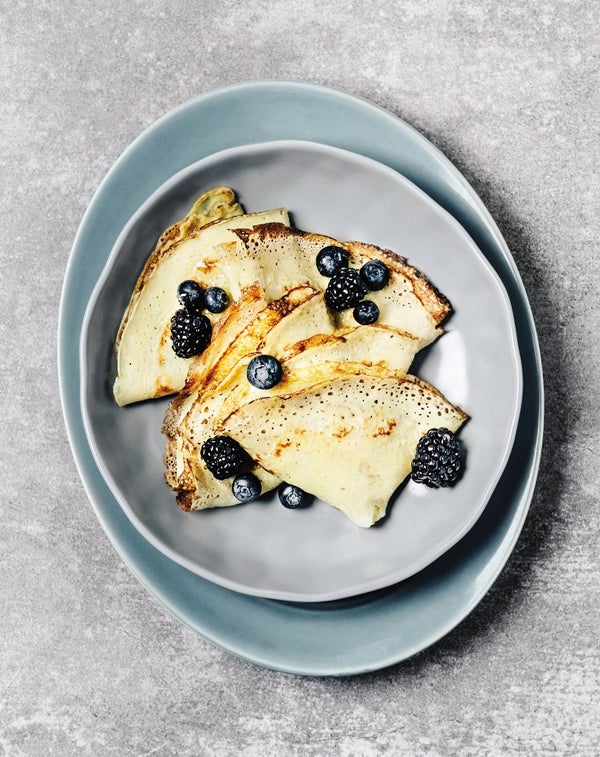
With a little help from computer simulations and fluid dynamics, engineers have finally optimized the craft of crepe making.
So suggests a new study involving these paper-thin, tricky-to-make pancakes, which are often filled with chocolate, cheese or jam. By simulating the behavior of batter poured across a tilting and rotating hot surface, a pair of engineers—separated by half the world but united in their passion for brunch—mathematically determined the pan-angle-and-swirl conditions that give rise to ideal crepes.
The investigation was the brainchild of Mathieu Sellier, an engineer at New Zealand's University of Canterbury, who studies fluid systems at scales from microscopic channels to glacier flows. He also serves as chief brunch maker in his home and had often wondered: What's the best way to coat the pan thinly and evenly with batter?
On supporting science journalism
If you're enjoying this article, consider supporting our award-winning journalism by subscribing. By purchasing a subscription you are helping to ensure the future of impactful stories about the discoveries and ideas shaping our world today.
In 2016 Sellier mentioned the crepe conundrum to Edouard Boujo, an engineer now at École Polytechnique in France, who studies optimization. They recast the problem in mathematical terms: How does one minimize the difference in thickness between a real-world pancake and an ideal, uniformly flat one? Their results appeared in June in Physical Review Fluids.
The optimal technique the duo found—to pour batter into the hot pan, tilt the pan to spread it to the edge and swirl to distribute it evenly—should not come as a surprise to expert crepe cookers. But its implications reach beyond the kitchen.
“This is a really good way of simplifying the problem,” says mathematician Matthew Moore of the University of Oxford, who was not involved in the study (but admits to a weakness for savory crepes). He says that probing what happens at the transition between liquid and solid states can often get complicated. Treating crepe making as an optimization problem is a strategy that could be useful for other tasks.
The crepe-making process is similar to techniques for adding thin layers to microchips and evenly applying paint to a car—applications that the engineers say could benefit from their approach. “The connection is that you want to spread your liquid in a thin, uniform layer,” Sellier says. “It's the same problem in a lot of cases.”