
In Plato’s allegory of the cave, chained prisoners face a blank cavern wall from the time they are born, the only reality they have ever known. When people and objects passing behind the captives project shadows on the wall, the prisoners believe that their experience of the world is complete, never realizing that their knowledge is impoverished to a vast degree.
A new virtual art exhibit, hosted by the National Museum of Mathematics in New York City, highlights how, whenever we examine a three-dimensional item from a single vantage point, we only ever observe a partial projection, or shadow, of the entire object in front of us. Because we experience the 3-D world around us through the filter of our 2-D retinas, our visual experience is sometimes no better than that of the unfortunates in Plato’s cave.

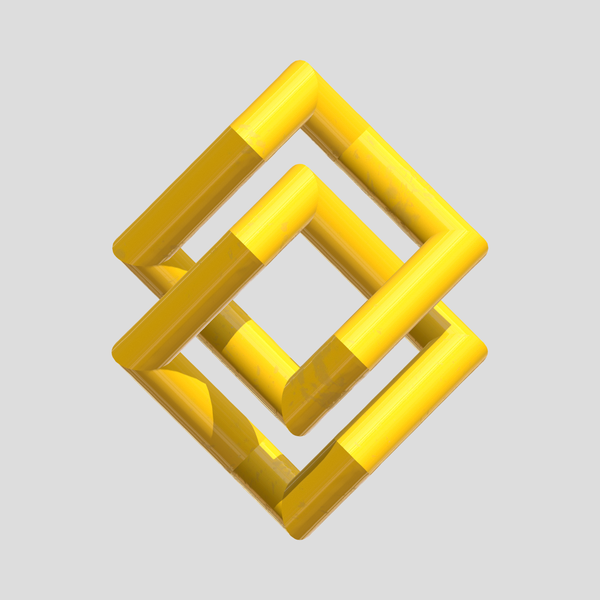
Opus 125707, by Dutch sculptor Anton Bakker. Each image represents a different perspective of the same 3-D object. Credit: Anton Bakker
On supporting science journalism
If you're enjoying this article, consider supporting our award-winning journalism by subscribing. By purchasing a subscription you are helping to ensure the future of impactful stories about the discoveries and ideas shaping our world today.
The intellectual heir of Dutch graphic artist M. C. Escher, Anton Bakker is a contemporary artist exploring the intersection of math, art and illusion. Influenced by Escher’s unique approach to perspective, Bakker uses computer-based methods to find unexpected and ambiguous viewpoints within cubic lattices and polyhedra. “Everything that exists, every piece of matter, is built from these structures,” says Bakker about cubic lattices, which form the basis of the most stable molecular forms of many elements. “I get goosebumps when I pursue a hunch about what exists in a lattice and discover an illusion of stunning beauty.”
Bakker’s mathematical sculptures—whether rendered in steel, bronze or virtually—underscore how different takes on the same lattice can change the apparent reality of the structure, revealing the “multiplicity of perspectives inherent in all things.” The overarching principle is not exclusive to Bakker’s creations; it is a fundamental problem in everyday vision, where our brains must resolve profoundly ambiguous incoming information into one of many possible perceptual solutions.
“The brain thinks it sees two linked squares [from a certain viewpoint],” says Bakker about his Opus 125707, featured at the top of this page. Without studying the other perspectives, viewers may walk away with a false interpretation about the simplicity of the structure they think they have seen. Yet the reality is far more complex than revealed by that first, accidental view—and there are lots more such riddles to discover, hidden in the lattices. “I’ve been playing in this sandbox for 40 years, and I will continue to play in it for the rest of my days,” Bakker says.