
Our growing list of sounds on Mars now includes lasers.
NASA’s Perseverance rover has begun using its rock-zapping SuperCam instrument on the Red Planet, mission team members announced today (March 10). SuperCam is equipped with a microphone, which has picked up the gentle whoosh of the Martian wind as well as the not-so-gentle snaps generated by the laser when it hits a rock target.
“These recordings have demonstrated that our microphone is not only functioning well, but we also have a very high-quality signal for our scientific studies,” SuperCam team member Naomi Murdoch, a researcher at the Institut Supérieur de l’Aéronautique et de l’Espace in Toulouse, France, said during a live webcast today.
On supporting science journalism
If you're enjoying this article, consider supporting our award-winning journalism by subscribing. By purchasing a subscription you are helping to ensure the future of impactful stories about the discoveries and ideas shaping our world today.
“In the SuperCam team, we’re extremely excited about the perspectives and the scientific investigations that we’re going to be able to do with the microphone data,” Murdoch said.
The car-sized Perseverance, the centerpiece of NASA’s $2.7 billion Mars 2020 mission, landed on the floor of Jezero Crater on Feb. 18. The rover’s main tasks involve hunting for signs of ancient life within the 28-mile-wide (45 kilometers) Jezero, which harbored a deep lake and a river delta billions of years ago, and collecting dozens of samples for future return to Earth.
SuperCam, which sits on Perseverance’s headlike mast, is one of the seven science instruments the rover will use to do this off-world work. SuperCam fires a laser at targets up to 23 feet (7 meters) away, generating a cloud of vaporized rock, the composition of which can be determined by the instrument’s cameras and spectrometers.
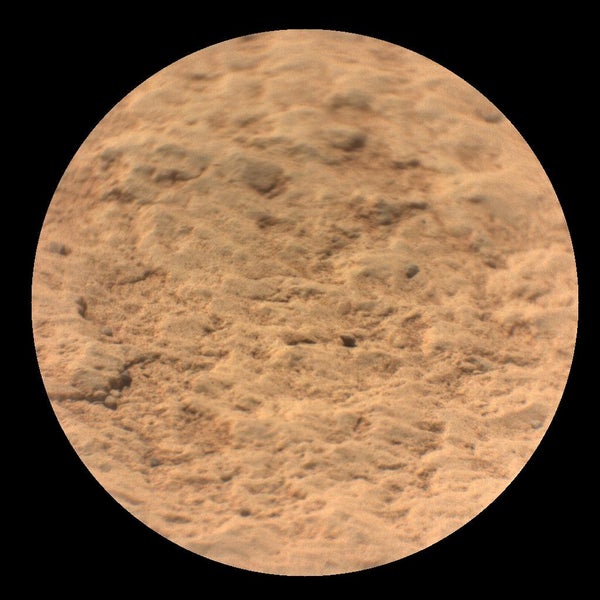
As Murdoch and her colleagues announced today, such rock zapping has already begun. SuperCam fired on a target named Máaz, the Navajo word for Mars, on March 2. (Perseverance is exploring a part of Jezero the team has dubbed Canyon de Chelly, after a national monument on Navajo land in northeastern Arizona.)
The SuperCam observations allowed the team to determine that Máaz has a basaltic composition. Basalts are igneous, or volcanic, rocks that are common on Mars as well as Earth. But it’s unclear at the moment if Máaz itself is volcanic, said SuperCam principal investigator Roger Wiens of Los Alamos National Laboratory, a U.S. Department of Energy facility in New Mexico.
It’s also possible that Máaz “is a sedimentary rock composed of igneous grains that were washed downriver into Jezero Lake and cemented together,” Wiens said during today’s update.
The SuperCam mic recorded audio of the Martian wind during Perseverance’s first few days on Mars, the instrument team announced today. The microphone also captured the countless rapid-fire snaps of the Máaz work, which came from shock waves generated by the heat and vibration of the rock vaporization.
Such audio will be quite useful to the SuperCam team, Murdoch said. For example, details of the snaps will reveal the hardness of each rock target, a detail that cannot be determined from composition alone. (Chalk and marble have the same chemical composition, as Murdoch pointed out.)
SuperCam recordings will also help the Perseverance team keep tabs on the rover and its various subsystems and allow researchers to better understand the thin, carbon-dioxide dominated Martian atmosphere, Murdoch said.
Perseverance carries another microphone as well—one that’s built into its entry, descent and landing (EDL) camera system. The EDL mic didn’t record sound during the rover’s “seven minutes of terror” touchdown on Feb. 18, but it has captured audio on the Martian surface.
These two microphones are the first ever to record true audio on Mars. And they may work together at some point; mission team members have discussed the possibility of operating both mics simultaneously to capture stereo sound on the Red Planet.
Perseverance has not begun its science work in earnest yet. The first big task for the rover involves finding a suitable airfield for the rover’s helicopter, a 4-lb. (1.8 kilograms) craft named Ingenuity, to make its technology-demonstrating flights.
Perseverance will attempt to document Ingenuity’s forays into the Martian sky. And this might even be a multimedia extravaganza: It’s possible that one or both mics could capture the sounds of Ingenuity’s rotors churning through the thin Martian air, mission team members have said.
Copyright 2021 Space.com, a Future company. All rights reserved. This material may not be published, broadcast, rewritten or redistributed.