
NASA’s newest Mars rover is settling nicely into its new home.
The Perseverance rover landed inside Mars’ Jezero Crater on Feb. 18, on a mission to hunt for evidence of past microbial life and collectsamples for future return to Earth. For the past month, the mission team has been checking out Perseverance’s seven science instruments and its various subsystems, and the rover has jumped through every hoop.
“So far, all of this has been going exceedingly well,” Perseverance project scientist Ken Farley, of NASA’s Jet Propulsion Laboratory in Southern California, said on Tuesday (March 16) during a webcast presentation at the 52nd Lunar and Planetary Science Conference (LPSC). “We’ve had no major technical issues.”
On supporting science journalism
If you're enjoying this article, consider supporting our award-winning journalism by subscribing. By purchasing a subscription you are helping to ensure the future of impactful stories about the discoveries and ideas shaping our world today.
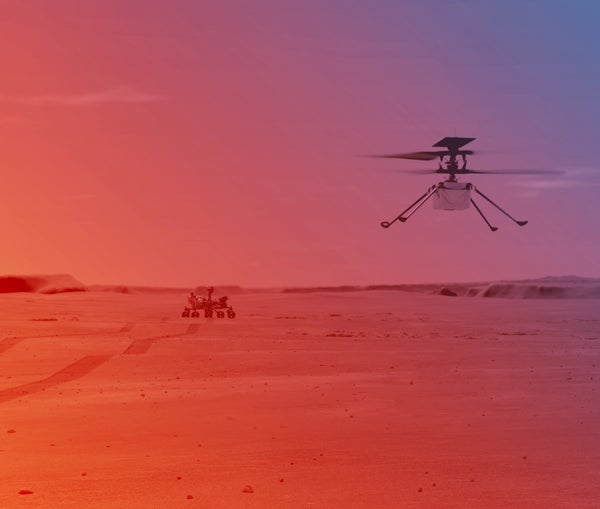
Perseverance’s first big task after finishing these checkouts is to get its tiny helicopter buddy aloft. The 4-lb. (1.8 kilograms) chopper, named Ingenuity, traveled to Mars tucked into the rover’s belly and, once the mission team finds a suitable airfield for the test, will deploy to attempt a few short technology-demonstrating flights.
Those flights will be the first ever made by a rotorcraft on a world beyond Earth. If Ingenuity performs well, future Mars missions could routinely include helicopters, which could both serve as scouts for rovers and gather data on their own, NASA officials have said.
After deploying Ingenuity, Perseverance will drive a safe distance away and attempt to document the aerial action with the rover’s high-resolution Mastcam-Z camera suite.
“We plan to use our video capability and our telephoto capability,” Mastcam-Z principal investigator Jim Bell, of Arizona State University, said during a different LPSC presentation on Tuesday. “It’ll be very exciting, and we’re looking forward to those historic, aviation-first kind of movies.”
Perseverance may also be able to record audio of Ingenuity’s flights using its two onboard microphones, mission team members have said.
Those flights are expected to take place this spring. After they’re done, Perseverance will dive into its science work in earnest on Jezero’s floor, which hosted a big lake and a river delta billions of years ago. The mission team has already mapped out a tentative traverse, which would take the rover through the delta region, up onto Jezero’s rim and onto the plains beyond the crater, Farley said.
This notional plan would require about 22 miles (35 kilometers) of driving spread over two mission phases, “Jezero” and “Beyond Jezero." And Perseverance couldn’t journey so far during its prime mission of one Mars year, or 687 Earth days; it would require a mission extension through 2028, Farley said.
The current plan—which, again, is subject to change—also envisions two caches of sampled material. Perseverance would stash about 10 tubes of Mars dirt and rock somewhere in Jezero and another 28 beyond the crater’s rim.
This plan “involves a lot of driving, but it would produce a really fantastic diversity of rock samples from two really different environments in Jezero and beyond Jezero,” Farley said.
(Precedent suggests that Perseverance could handle a long, driving-heavy stint on Mars. The six-wheeled robot is based heavily on NASA’s Curiosity rover, which has put about 15.5 miles (25 km) on its odometer since landing inside the Red Planet’s Gale Crater in August 2012 and is still going strong.)
Perseverance’s samples will be returned to Earth, perhaps as early as 2031, by a joint NASA-European Space Agency (ESA) campaign, which has yet to get off the ground. The samples will be collected by an ESA-built “fetch rover,” launch off the Martian surface in a NASA-provided rocket and be hauled home by an ESA spacecraft after a handoff in Mars orbit.
Once on Earth, these pristine samples will be studied by scientists around the world in far greater detail than Perseverance, able and complex though the robot is, can muster all by its lonesome on the Martian surface.
So stay tuned; Perseverance’s mission is about to get a lot more action-packed. And that’s saying something—the mission team has already uploaded more than 10,000 photos snapped by the rover, which you can peruse here.
Copyright 2021 Space.com, a Future company. All rights reserved. This material may not be published, broadcast, rewritten or redistributed.